Madras Legislative Council
5 languages
Tools
:
From
Wikipedia,
the free encyclopedia
(Redirected from
)
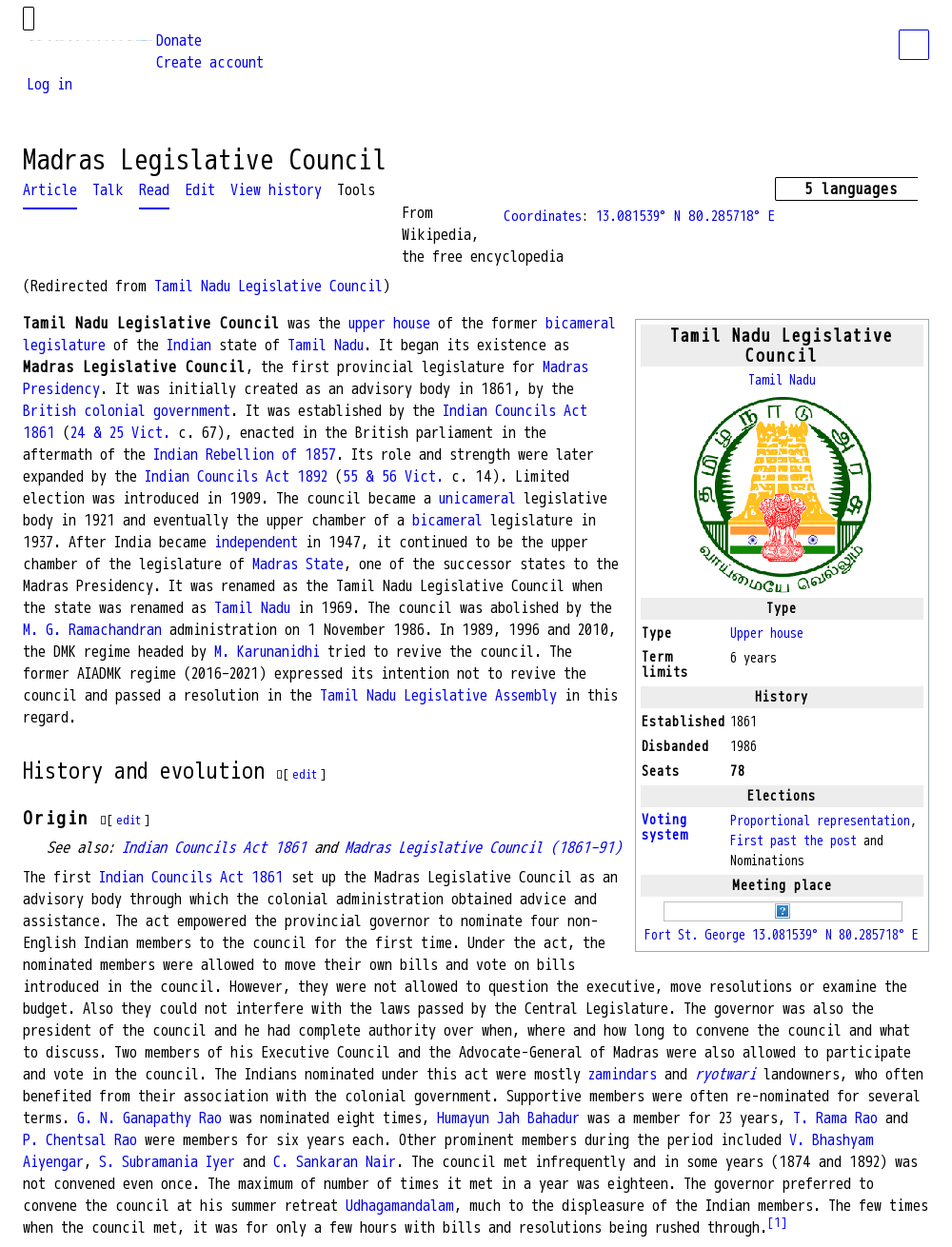
Tamil Nadu Legislative
Council
Type
Type
Term
limits
6 years
History
Established
1861
Disbanded
1986
Seats
78
Elections
,
and
Nominations
Meeting place
Tamil Nadu Legislative Council
was the
of the former
of the
state of
. It began its existence as
Madras Legislative Council
, the first provincial legislature for
. It was initially created as an advisory body in 1861, by the
. It was established by the
(
c. 67), enacted in the British parliament in the
aftermath of the
. Its role and strength were later
expanded by the
(
c. 14). Limited
election was introduced in 1909. The council became a
legislative
body in 1921 and eventually the upper chamber of a
legislature in
1937. After India became
in 1947, it continued to be the upper
chamber of the legislature of
, one of the successor states to the
Madras Presidency. It was renamed as the Tamil Nadu Legislative Council when
the state was renamed as
in 1969. The council was abolished by the
administration on 1 November 1986. In 1989, 1996 and 2010,
the DMK regime headed by
tried to revive the council. The
former AIADMK regime (2016–2021) expressed its intention not to revive the
council and passed a resolution in the
in this
regard.
History and evolution
[
]
Origin
[
]
See also:
and
The first
set up the Madras Legislative Council as an
advisory body through which the colonial administration obtained advice and
assistance. The act empowered the provincial governor to nominate four non-
English Indian members to the council for the first time. Under the act, the
nominated members were allowed to move their own bills and vote on bills
introduced in the council. However, they were not allowed to question the executive, move resolutions or examine the
budget. Also they could not interfere with the laws passed by the Central Legislature. The governor was also the
president of the council and he had complete authority over when, where and how long to convene the council and what
to discuss. Two members of his Executive Council and the Advocate-General of Madras were also allowed to participate
and vote in the council. The Indians nominated under this act were mostly
and
landowners, who often
benefited from their association with the colonial government. Supportive members were often re-nominated for several
terms.
was nominated eight times,
was a member for 23 years,
and
were members for six years each. Other prominent members during the period included
,
and
. The council met infrequently and in some years (1874 and 1892) was
not convened even once. The maximum of number of times it met in a year was eighteen. The governor preferred to
convene the council at his summer retreat
, much to the displeasure of the Indian members. The few times
when the council met, it was for only a few hours with bills and resolutions being rushed through.
Expansion
[
]
See also:
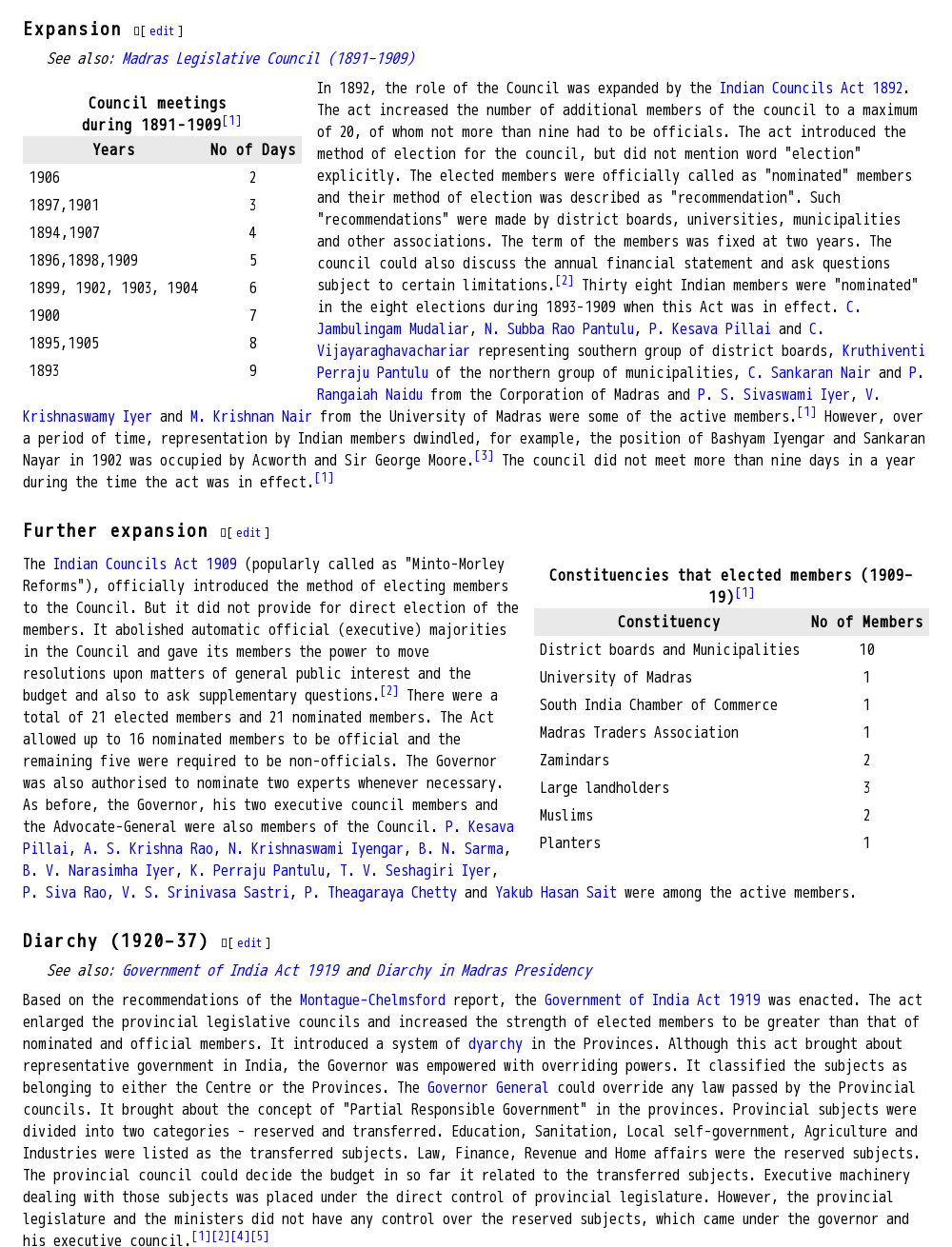
Council meetings
during 1891-1909
Years
No of Days
1906
2
1897,1901
3
1894,1907
4
1896,1898,1909
5
1899, 1902, 1903, 1904
6
1900
7
1895,1905
8
1893
9
In 1892, the role of the Council was expanded by the
.
The act increased the number of additional members of the council to a maximum
of 20, of whom not more than nine had to be officials. The act introduced the
method of election for the council, but did not mention word "election"
explicitly. The elected members were officially called as "nominated" members
and their method of election was described as "recommendation". Such
"recommendations" were made by district boards, universities, municipalities
and other associations. The term of the members was fixed at two years. The
council could also discuss the annual financial statement and ask questions
subject to certain limitations.
Thirty eight Indian members were "nominated"
in the eight elections during 1893-1909 when this Act was in effect.
,
,
and
representing southern group of district boards,
of the northern group of municipalities,
and
from the Corporation of Madras and
,
and
from the University of Madras were some of the active members.
However, over
a period of time, representation by Indian members dwindled, for example, the position of Bashyam Iyengar and Sankaran
Nayar in 1902 was occupied by Acworth and Sir George Moore.
The council did not meet more than nine days in a year
during the time the act was in effect.
Further expansion
[
]
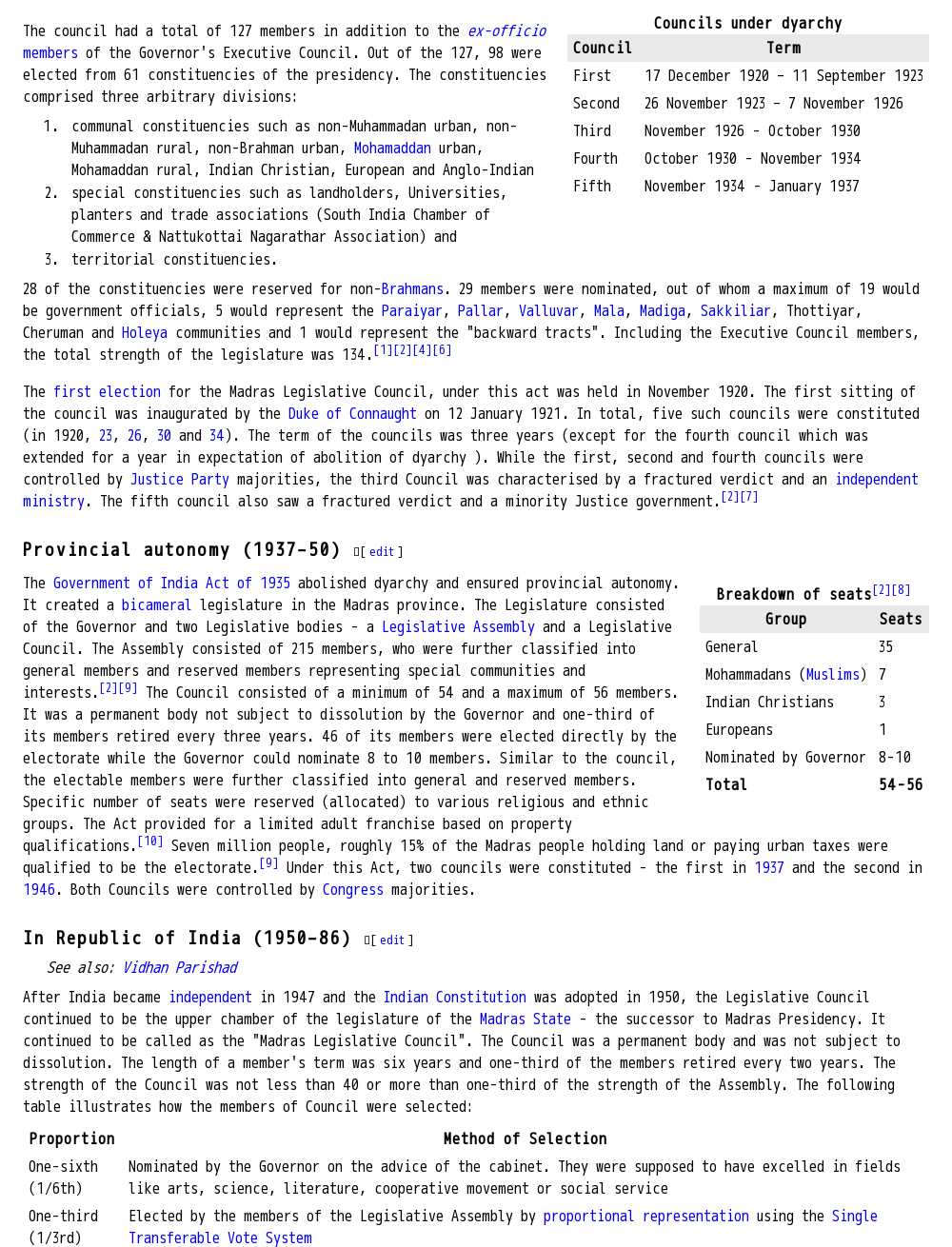
Constituencies that elected members (1909–
19)
Constituency
No of Members
District boards and Municipalities
10
University of Madras
1
South India Chamber of Commerce
1
Madras Traders Association
1
Zamindars
2
Large landholders
3
Muslims
2
Planters
1
The
(popularly called as "Minto-Morley
Reforms"), officially introduced the method of electing members
to the Council. But it did not provide for direct election of the
members. It abolished automatic official (executive) majorities
in the Council and gave its members the power to move
resolutions upon matters of general public interest and the
budget and also to ask supplementary questions.
There were a
total of 21 elected members and 21 nominated members. The Act
allowed up to 16 nominated members to be official and the
remaining five were required to be non-officials. The Governor
was also authorised to nominate two experts whenever necessary.
As before, the Governor, his two executive council members and
the Advocate-General were also members of the Council.
,
,
,
,
,
,
,
,
,
and
were among the active members.
Diarchy (1920–37)
[
]
See also:
and
Based on the recommendations of the
report, the
was enacted. The act
enlarged the provincial legislative councils and increased the strength of elected members to be greater than that of
nominated and official members. It introduced a system of
in the Provinces. Although this act brought about
representative government in India, the Governor was empowered with overriding powers. It classified the subjects as
belonging to either the Centre or the Provinces. The
could override any law passed by the Provincial
councils. It brought about the concept of "Partial Responsible Government" in the provinces. Provincial subjects were
divided into two categories - reserved and transferred. Education, Sanitation, Local self-government, Agriculture and
Industries were listed as the transferred subjects. Law, Finance, Revenue and Home affairs were the reserved subjects.
The provincial council could decide the budget in so far it related to the transferred subjects. Executive machinery
dealing with those subjects was placed under the direct control of provincial legislature. However, the provincial
legislature and the ministers did not have any control over the reserved subjects, which came under the governor and
his executive council.
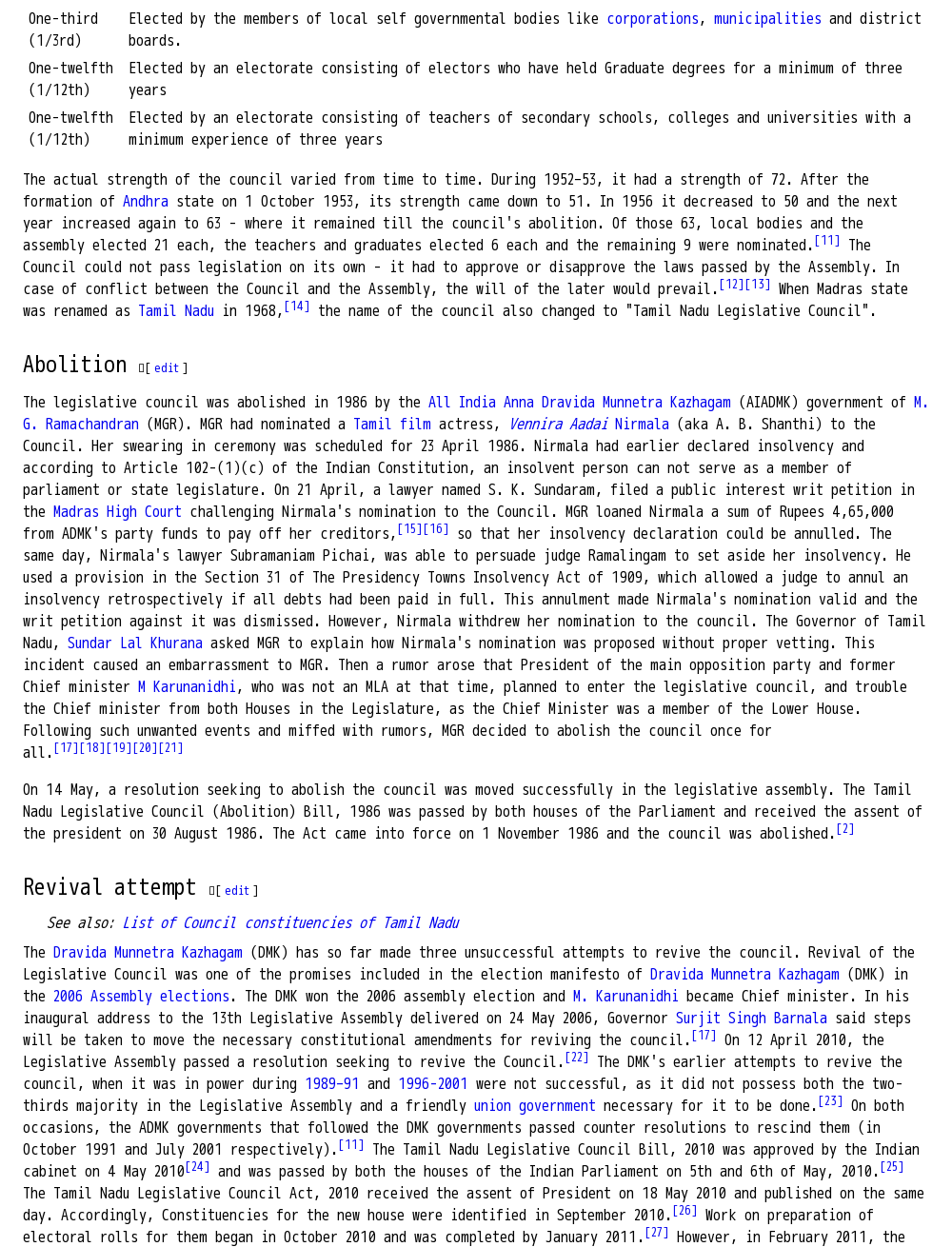
Councils under dyarchy
Council
Term
First
17 December 1920 – 11 September 1923
Second
26 November 1923 – 7 November 1926
Third
November 1926 - October 1930
Fourth
October 1930 - November 1934
Fifth
November 1934 - January 1937
The council had a total of 127 members in addition to the
of the Governor's Executive Council. Out of the 127, 98 were
elected from 61 constituencies of the presidency. The constituencies
comprised three arbitrary divisions:
communal constituencies such as non-Muhammadan urban, non-
Muhammadan rural, non-Brahman urban,
urban,
Mohamaddan rural, Indian Christian, European and Anglo-Indian
special constituencies such as landholders, Universities,
planters and trade associations (South India Chamber of
Commerce & Nattukottai Nagarathar Association) and
territorial constituencies.
28 of the constituencies were reserved for non-
. 29 members were nominated, out of whom a maximum of 19 would
be government officials, 5 would represent the
,
,
,
,
,
, Thottiyar,
Cheruman and
communities and 1 would represent the "backward tracts". Including the Executive Council members,
the total strength of the legislature was 134.
The
for the Madras Legislative Council, under this act was held in November 1920. The first sitting of
the council was inaugurated by the
on 12 January 1921. In total, five such councils were constituted
(in 1920,
,
,
and
). The term of the councils was three years (except for the fourth council which was
extended for a year in expectation of abolition of dyarchy ). While the first, second and fourth councils were
controlled by
majorities, the third Council was characterised by a fractured verdict and an
. The fifth council also saw a fractured verdict and a minority Justice government.
Provincial autonomy (1937–50)
[
]
Breakdown of seats
Group
Seats
General
35
Mohammadans (
)
7
Indian Christians
3
Europeans
1
Nominated by Governor
8-10
Total
54-56
The
abolished dyarchy and ensured provincial autonomy.
It created a
legislature in the Madras province. The Legislature consisted
of the Governor and two Legislative bodies - a
and a Legislative
Council. The Assembly consisted of 215 members, who were further classified into
general members and reserved members representing special communities and
interests.
The Council consisted of a minimum of 54 and a maximum of 56 members.
It was a permanent body not subject to dissolution by the Governor and one-third of
its members retired every three years. 46 of its members were elected directly by the
electorate while the Governor could nominate 8 to 10 members. Similar to the council,
the electable members were further classified into general and reserved members.
Specific number of seats were reserved (allocated) to various religious and ethnic
groups. The Act provided for a limited adult franchise based on property
qualifications.
Seven million people, roughly 15% of the Madras people holding land or paying urban taxes were
qualified to be the electorate.
Under this Act, two councils were constituted - the first in
and the second in
. Both Councils were controlled by
majorities.
In Republic of India (1950–86)
[
]
See also:
After India became
in 1947 and the
was adopted in 1950, the Legislative Council
continued to be the upper chamber of the legislature of the
- the successor to Madras Presidency. It
continued to be called as the "Madras Legislative Council". The Council was a permanent body and was not subject to
dissolution. The length of a member's term was six years and one-third of the members retired every two years. The
strength of the Council was not less than 40 or more than one-third of the strength of the Assembly. The following
table illustrates how the members of Council were selected:
Proportion
Method of Selection
One-sixth
(1/6th)
Nominated by the Governor on the advice of the cabinet. They were supposed to have excelled in fields
like arts, science, literature, cooperative movement or social service
One-third
(1/3rd)
Elected by the members of the Legislative Assembly by
using the
One-third
(1/3rd)
Elected by the members of local self governmental bodies like
,
and district
boards.
One-twelfth
(1/12th)
Elected by an electorate consisting of electors who have held Graduate degrees for a minimum of three
years
One-twelfth
(1/12th)
Elected by an electorate consisting of teachers of secondary schools, colleges and universities with a
minimum experience of three years
The actual strength of the council varied from time to time. During 1952–53, it had a strength of 72. After the
formation of
state on 1 October 1953, its strength came down to 51. In 1956 it decreased to 50 and the next
year increased again to 63 - where it remained till the council's abolition. Of those 63, local bodies and the
assembly elected 21 each, the teachers and graduates elected 6 each and the remaining 9 were nominated.
The
Council could not pass legislation on its own - it had to approve or disapprove the laws passed by the Assembly. In
case of conflict between the Council and the Assembly, the will of the later would prevail.
When Madras state
was renamed as
in 1968,
the name of the council also changed to "Tamil Nadu Legislative Council".
Abolition
[
]
The legislative council was abolished in 1986 by the
(AIADMK) government of
(MGR). MGR had nominated a
actress,
(aka A. B. Shanthi) to the
Council. Her swearing in ceremony was scheduled for 23 April 1986. Nirmala had earlier declared insolvency and
according to Article 102-(1)(c) of the Indian Constitution, an insolvent person can not serve as a member of
parliament or state legislature. On 21 April, a lawyer named S. K. Sundaram, filed a public interest writ petition in
the
challenging Nirmala's nomination to the Council. MGR loaned Nirmala a sum of Rupees 4,65,000
from ADMK's party funds to pay off her creditors,
so that her insolvency declaration could be annulled. The
same day, Nirmala's lawyer Subramaniam Pichai, was able to persuade judge Ramalingam to set aside her insolvency. He
used a provision in the Section 31 of The Presidency Towns Insolvency Act of 1909, which allowed a judge to annul an
insolvency retrospectively if all debts had been paid in full. This annulment made Nirmala's nomination valid and the
writ petition against it was dismissed. However, Nirmala withdrew her nomination to the council. The Governor of Tamil
Nadu,
asked MGR to explain how Nirmala's nomination was proposed without proper vetting. This
incident caused an embarrassment to MGR. Then a rumor arose that President of the main opposition party and former
Chief minister
, who was not an MLA at that time, planned to enter the legislative council, and trouble
the Chief minister from both Houses in the Legislature, as the Chief Minister was a member of the Lower House.
Following such unwanted events and miffed with rumors, MGR decided to abolish the council once for
all.
On 14 May, a resolution seeking to abolish the council was moved successfully in the legislative assembly. The Tamil
Nadu Legislative Council (Abolition) Bill, 1986 was passed by both houses of the Parliament and received the assent of
the president on 30 August 1986. The Act came into force on 1 November 1986 and the council was abolished.
Revival attempt
[
]
See also:
The
(DMK) has so far made three unsuccessful attempts to revive the council.
Revival of the
Legislative Council was one of the promises included in the election manifesto of
(DMK) in
the
. The DMK won the 2006 assembly election and
became Chief minister. In his
inaugural address to the 13th Legislative Assembly delivered on 24 May 2006, Governor
said steps
will be taken to move the necessary constitutional amendments for reviving the council.
On 12 April 2010, the
Legislative Assembly passed a resolution seeking to revive the Council.
The DMK's earlier attempts to revive the
council, when it was in power during
and
were not successful, as it did not possess both the two-
thirds majority in the Legislative Assembly and a friendly
necessary for it to be done.
On both
occasions, the ADMK governments that followed the DMK governments passed counter resolutions to rescind them (in
October 1991 and July 2001 respectively).
The Tamil Nadu Legislative Council Bill, 2010 was approved by the Indian
cabinet on 4 May 2010
and was passed by both the houses of the Indian Parliament on 5th and 6th of May, 2010.
The Tamil Nadu Legislative Council Act, 2010 received the assent of President on 18 May 2010 and published on the same
day. Accordingly, Constituencies for the new house were identified in September 2010.
Work on preparation of
electoral rolls for them began in October 2010 and was completed by January 2011.
However, in February 2011, the
stayed the elections to the new council, till the petitions challenging its revival could be
heard.
In the 2011 Assembly elections, the AIADMK came out with a sweeping majority. The AIADMK government headed by
J.Jayalalithaa expressed its intention not to revive the council. The government once again passed a counter
resolution to withdraw the attempt to revive the council.
As on now, despite the fact that there is a specific provision of a Legislative Council in Tamil Nadu in Article 168
of Constitution of India, there is no Legislative Council in Tamil Nadu for want of a resolution by the Tamil Nadu
Legislative Assembly by majority as provided in Article 169 of Constitution of India.
Location
[
]
Main article:
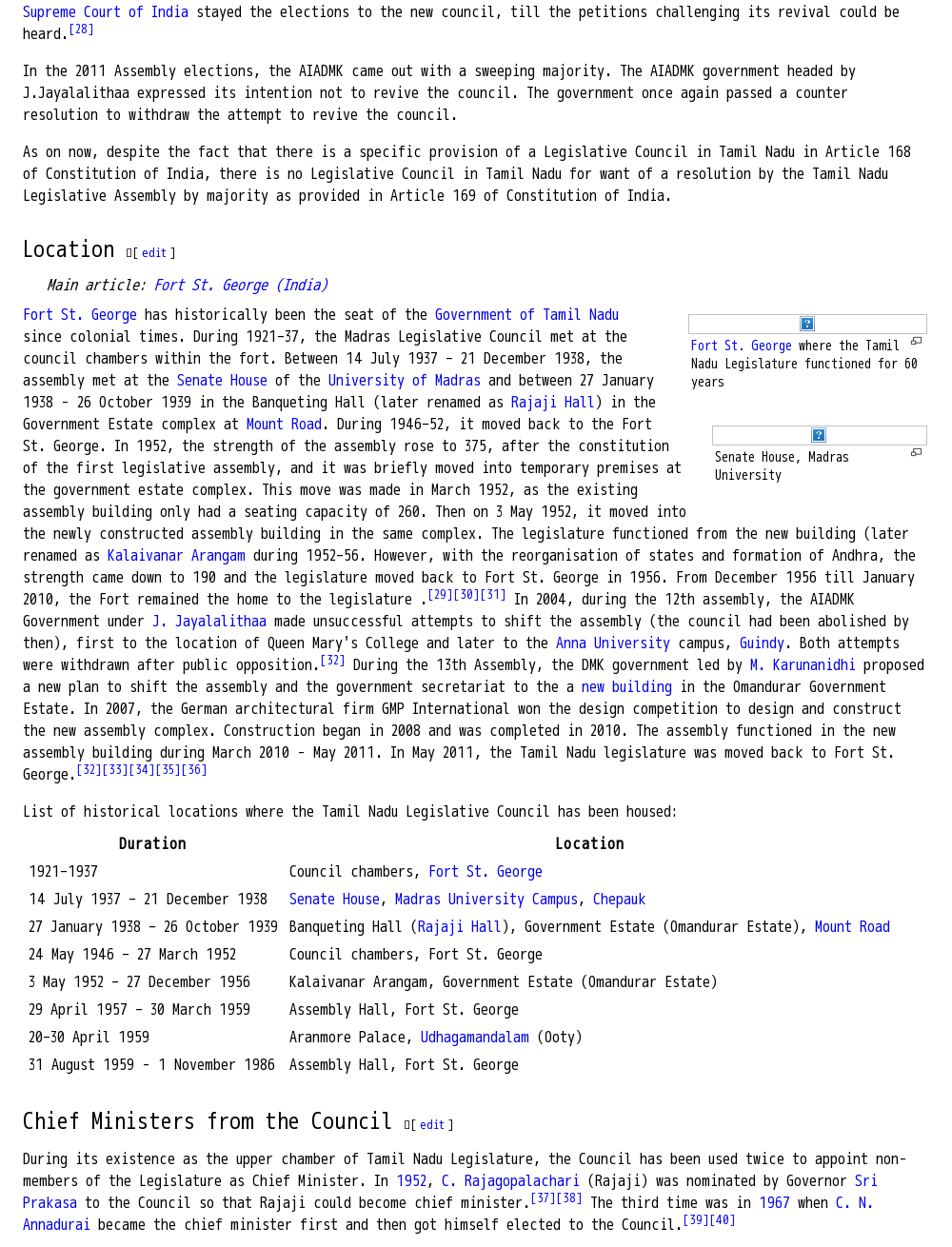
where the Tamil
Nadu Legislature functioned for 60
years
Senate House, Madras
University
has historically been the seat of the
since colonial times. During 1921–37, the Madras Legislative Council met at the
council chambers within the fort. Between 14 July 1937 – 21 December 1938, the
assembly met at the
of the
and between 27 January
1938 - 26 October 1939 in the Banqueting Hall (later renamed as
) in the
Government Estate complex at
.
During 1946–52, it moved back to the Fort
St. George. In 1952, the strength of the assembly rose to 375, after the constitution
of the first legislative assembly, and it was briefly moved into temporary premises at
the government estate complex. This move was made in March 1952, as the existing
assembly building only had a seating capacity of 260. Then on 3 May 1952, it moved into
the newly constructed assembly building in the same complex. The legislature functioned from the new building (later
renamed as
during 1952–56. However, with the reorganisation of states and formation of Andhra, the
strength came down to 190 and the legislature moved back to Fort St. George in 1956. From December 1956 till January
2010, the Fort remained the home to the legislature .
In 2004, during the 12th assembly, the AIADMK
Government under
made unsuccessful attempts to shift the assembly (the council had been abolished by
then), first to the location of Queen Mary's College and later to the
campus,
. Both attempts
were withdrawn after public opposition.
During the 13th Assembly, the DMK government led by
proposed
a new plan to shift the assembly and the government secretariat to the a
in the Omandurar Government
Estate. In 2007, the German architectural firm GMP International won the design competition to design and construct
the new assembly complex. Construction began in 2008 and was completed in 2010. The assembly functioned in the new
assembly building during March 2010 - May 2011. In May 2011, the Tamil Nadu legislature was moved back to Fort St.
George.
List of historical locations where the Tamil Nadu Legislative Council has been housed:
Duration
Location
1921–1937
Council chambers,
14 July 1937 – 21 December 1938
,
,
27 January 1938 – 26 October 1939
Banqueting Hall (
), Government Estate (Omandurar Estate),
24 May 1946 – 27 March 1952
Council chambers, Fort St. George
3 May 1952 – 27 December 1956
Kalaivanar Arangam, Government Estate (Omandurar Estate)
29 April 1957 – 30 March 1959
Assembly Hall, Fort St. George
20–30 April 1959
Aranmore Palace,
(Ooty)
31 August 1959 - 1 November 1986
Assembly Hall, Fort St. George
Chief Ministers from the Council
[
]
During its existence as the upper chamber of Tamil Nadu Legislature, the Council has been used twice to appoint non-
members of the Legislature as Chief Minister.
In
,
(Rajaji) was nominated by Governor
to the Council so that Rajaji could become chief minister.
The third time was in
when
became the chief minister first and then got himself elected to the Council.
Presiding Officers
[
]
This article is part of a series on the
(
)
Vacant
(
)
Deputy Speaker
(
)
(
)
(
)
Deputy Leader of the Opposition
(
)
Disbanded
Coalitions
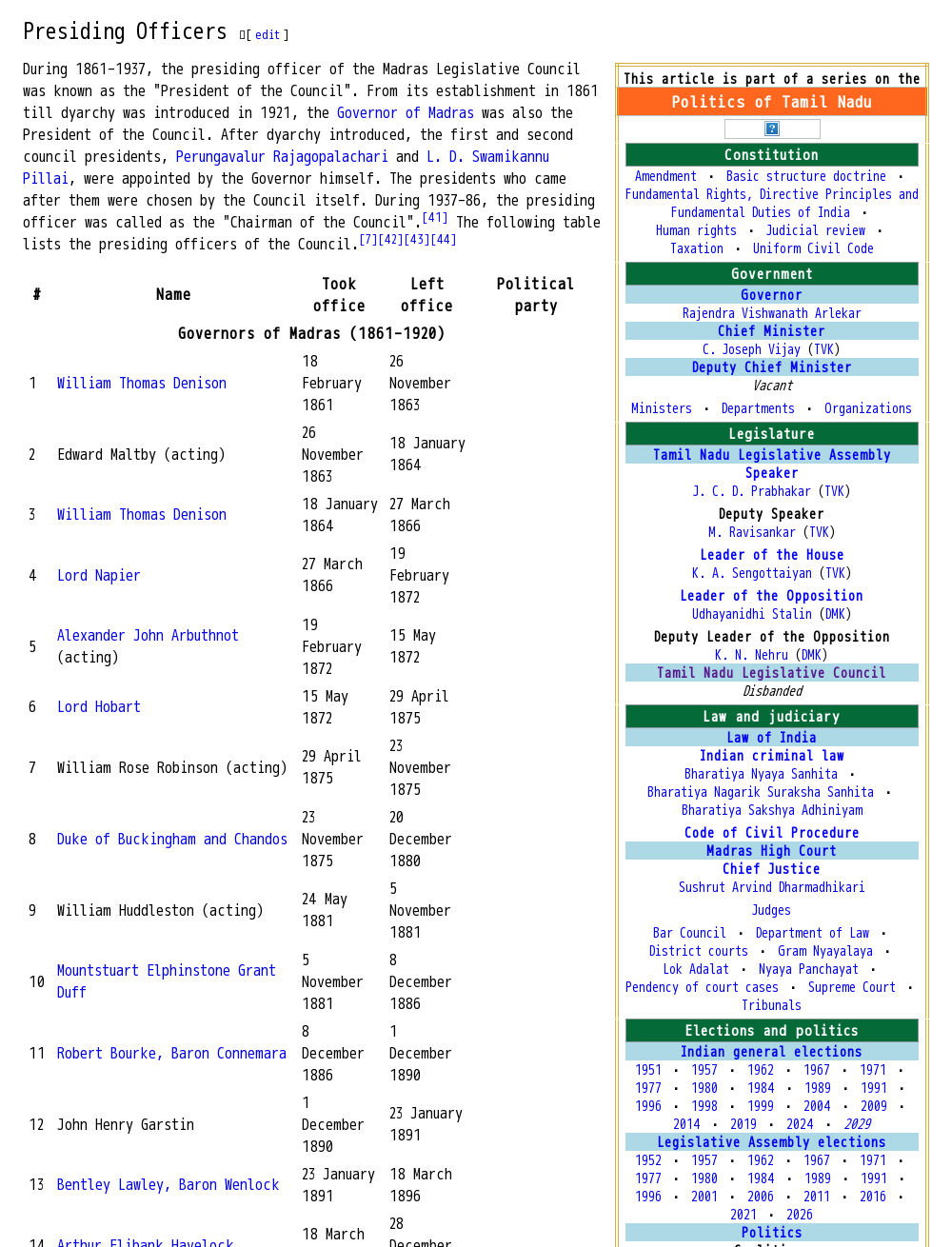
During 1861–1937, the presiding officer of the Madras Legislative Council
was known as the "President of the Council". From its establishment in 1861
till dyarchy was introduced in 1921, the
was also the
President of the Council. After dyarchy introduced, the first and second
council presidents,
and
, were appointed by the Governor himself. The presidents who came
after them were chosen by the Council itself. During 1937–86, the presiding
officer was called as the "Chairman of the Council".
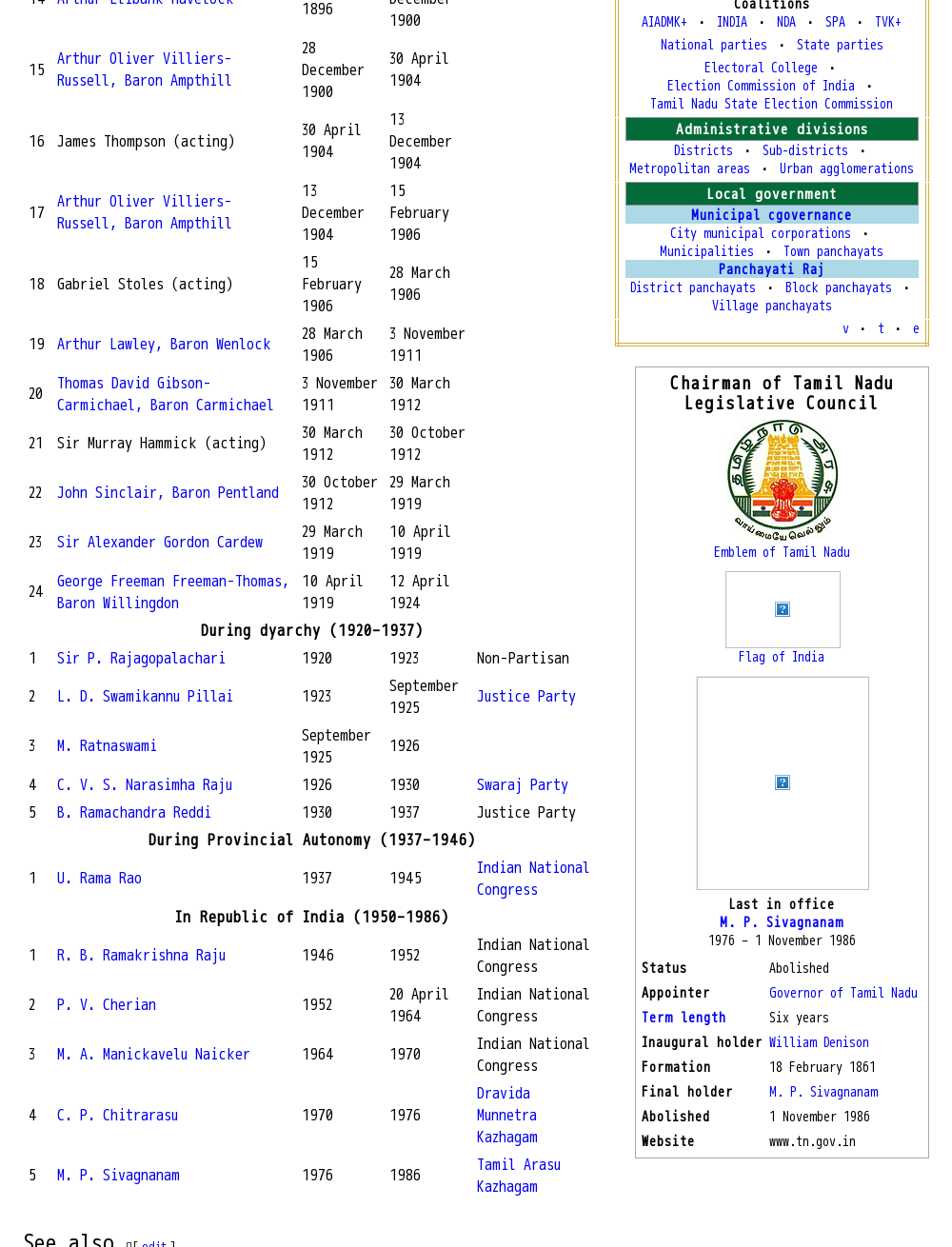
The following table
lists the presiding officers of the Council.
Chairman of Tamil Nadu
Legislative Council
Last in office
1976 – 1 November 1986
Status
Abolished
Appointer
Six years
Inaugural holder
Formation
18 February 1861
Final holder
Abolished
1 November 1986
Website
www.tn.gov.in
#
Name
Took
office
Left
office
Political
party
Governors of Madras (1861–1920)
1
18
February
1861
26
November
1863
2
Edward Maltby (acting)
26
November
1863
18 January
1864
3
18 January
1864
27 March
1866
4
27 March
1866
19
February
1872
5
(acting)
19
February
1872
15 May
1872
6
15 May
1872
29 April
1875
7
William Rose Robinson (acting)
29 April
1875
23
November
1875
8
23
November
1875
20
December
1880
9
William Huddleston (acting)
24 May
1881
5
November
1881
10
5
November
1881
8
December
1886
11
8
December
1886
1
December
1890
12
John Henry Garstin
1
December
1890
23 January
1891
13
23 January
1891
18 March
1896
14
18 March
1896
28
December
1900
15
28
December
1900
30 April
1904
16
James Thompson (acting)
30 April
1904
13
December
1904
17
13
December
1904
15
February
1906
18
Gabriel Stoles (acting)
15
February
1906
28 March
1906
19
28 March
1906
3 November
1911
20
3 November
1911
30 March
1912
21
Sir Murray Hammick (acting)
30 March
1912
30 October
1912
22
30 October
1912
29 March
1919
23
29 March
1919
10 April
1919
24
10 April
1919
12 April
1924
During dyarchy (1920–1937)
1
1920
1923
Non-Partisan
2
1923
September
1925
3
September
1925
1926
4
1926
1930
5
1930
1937
Justice Party
During Provincial Autonomy (1937–1946)
1
1937
1945
In Republic of India (1950–1986)
1
1946
1952
Indian National
Congress
2
1952
20 April
1964
Indian National
Congress
3
1964
1970
Indian National
Congress
4
1970
1976
5
1976
1986
See also
[
]
References
[
]
^
S. Krishnaswamy (1989).
The role of Madras Legislature in the freedom struggle, 1861-1947
. People's Pub. House
(New Delhi). pp.
5–
70,
72–
83.
^
.
Government
. Retrieved
17 December
2009
.
K. C. Markandan (1964).
Madras Legislative Council; Its constitution and working between 1861 and 1909
. S. Chand & CO. p. 76.
^
. Government of India
. Retrieved
17 December
2009
.
Rajaraman, P. (1988).
. Poompozhil Publishers. p. 206.
Mithra, H.N. (2009).
. BiblioBazaar. pp.
186–
199.
.
^
Rajaraman, P. (1988).
. Poompozhil Publishers. pp.
212–
220.
. Indian Government
. Retrieved
25 November
2009
.
^
Christopher Baker (1976), "The Congress at the 1937 Elections in Madras",
Modern Asian Studies
,
10
(4):
557–
589,
:
,
,
Low, David Anthony (1993).
. Cambridge University Press. p. 154.
.
^
Ramakrishnan, T (8 April 2010).
.
The Hindu
. Retrieved
8 April
2010
.
Darpan, Pratiyogita (2008),
,
,
2
(22): 60
Sharma, B. K. (2007).
. PHI Learning Pvt. Ltd. pp.
207–
218.
.
"C. N. Annadurai: a timeline".
.
. 15 September 2009.
.
.
. 14 June 2002
. Retrieved
23 December
2009
.
.
.
. 6 June 2007. Archived from
on 8 June 2007
. Retrieved
23 December
2009
.
^
.
. 24 May 2006
. Retrieved
23 December
2009
.
indiaabroad (4 March 2009).
.
. Retrieved
23 December
2009
.
(17 March 2009).
.
Galatta
. Retrieved
23 December
2009
.
[
]
(26 March 2009).
.
Galatta
. Retrieved
23 December
2009
.
[
]
India Today, Vol 11 (1986).
.
. Retrieved
23 December
2009
.
{{
}}
:
|work=
ignored (
)
.
. 12 April 2010. Archived from
on 14 April 2010
. Retrieved
13 April
2010
.
Arun Ram (26 May 2006).
.
. Diligent Media Corporation
. Retrieved
23 December
2009
.
.
The Hindu
. 4 May 2010
. Retrieved
5 May
2010
.
.
The Hindu
. 6 May 2010
. Retrieved
7 May
2010
.
21 July 2011 at the
.
. 24 October 2010. Archived from
on 28 October 2010
.
Retrieved
27 October
2010
.
.
. 22 February 2011.
from the original on 4 November 2012
.
Retrieved
23 February
2011
.
Karthikeyan, Ajitha (22 July 2008).
.
. Archived from
on 11 August 2011
. Retrieved
11 February
2010
.
(28 July 2008). "From Assembly to theatre".
.
(PDF)
.
.
Retrieved
11 February
2010
.
^
S, Murari (15 January 2010).
.
Asian
Tribune
. Retrieved
11 February
2010
.
Ramakrishnan, T (11 March 2010).
.
The Hindu
.
Retrieved
18 March
2010
.
Ramakrishnan, T. (19 April 2008).
.
. Archived from
on 22 April 2008
. Retrieved
11 February
2010
.
Ramakrishnan, T (13 March 2010).
.
. Retrieved
18 March
2010
.
Ramakrishnan, T (24 May 2011).
.
The Hindu
. Retrieved
23 June
2011
.
C. V. Gopalakrishnan (31 May 2001).
.
.
. Retrieved
17 December
2009
.
T. V. R. Shenoy (22 August 2001).
. Rediff.
Pushpa Iyengar, Sugata Srinivasaraju,
,
Outlook India
, retrieved
16 November
2009
Gopal K. Bharghava, Shankarlal C. Bhatt (2005).
.
Delhi: Kalpaz Publications. p. 525.
.
Johari, J. C (2007).
. Sterling Publishers Pvt. Ltd. p. 226.
.
.
The Hindu
. 7 April 2010
. Retrieved
5 May
2010
.
Naidu, R. Janardhanam; K. Ramalingam; V. Subbiah (1974).
.
.
Worldstatesman
. Retrieved
5 May
2010
.
External links
[
]
18 September 2012 at the
of
Current
Former
Current
Former
:
This page was last edited on 16 May 2026, at 16:40
(UTC)
.
Text is available under the
;
additional terms may apply. By using this site, you agree to the
and
. Wikipedia® is a registered trademark of the
, a non-profit organization.