Türksat (satellite)
7 languages
Tools
From Wikipedia, the free encyclopedia
Türksat
is the name of a series of
operated or projected by the state-owned
Satellite telecommunication is provided by the
in
,
.
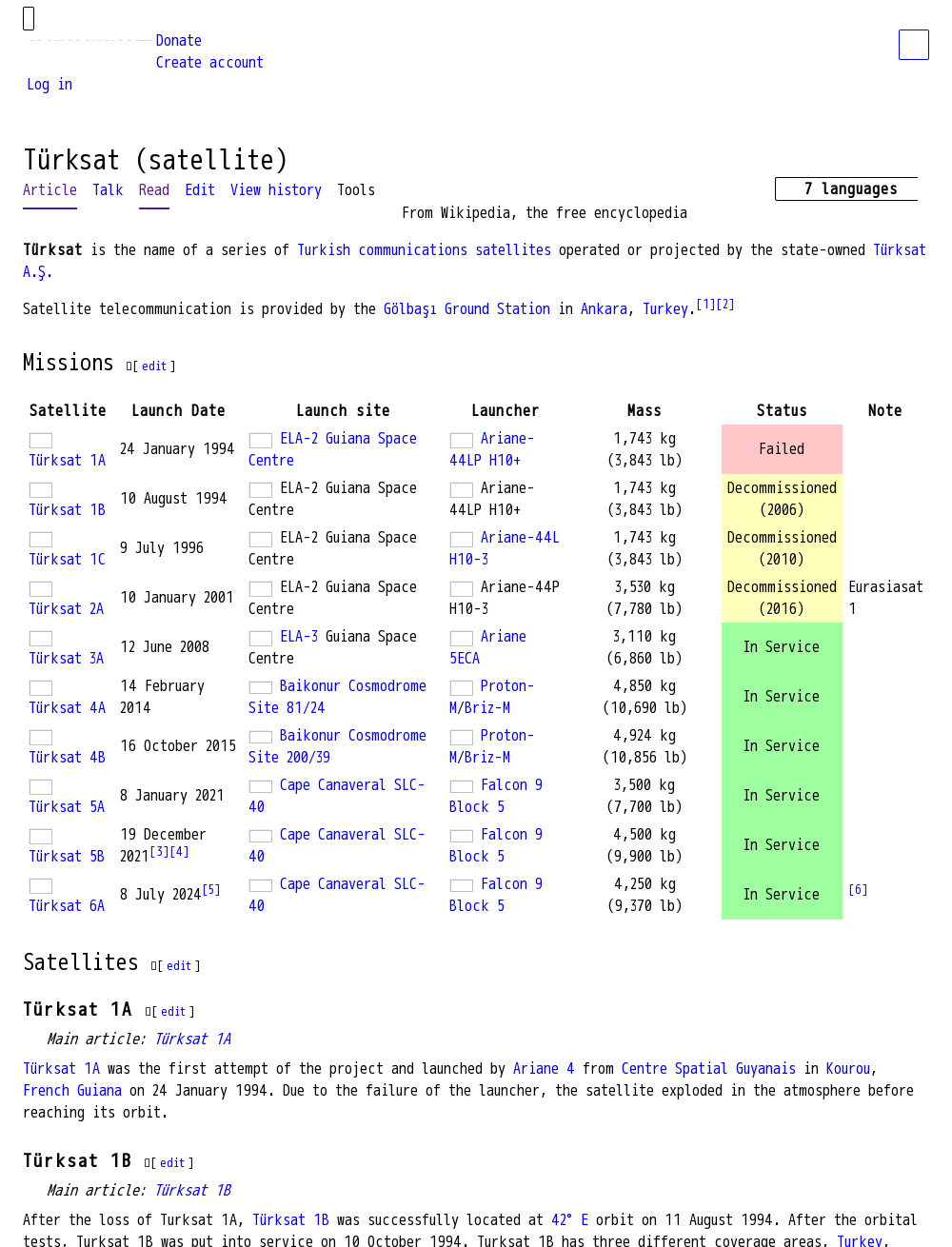
Missions
[
]
Satellite
Launch Date
Launch site
Launcher
Mass
Status
Note
24 January 1994
1,743 kg
(3,843 lb)
Failed
10 August 1994
ELA-2 Guiana Space
Centre
Ariane-
44LP H10+
1,743 kg
(3,843 lb)
Decommissioned
(2006)
9 July 1996
ELA-2 Guiana Space
Centre
1,743 kg
(3,843 lb)
Decommissioned
(2010)
10 January 2001
ELA-2 Guiana Space
Centre
Ariane-44P
H10-3
3,530 kg
(7,780 lb)
Decommissioned
(2016)
Eurasiasat
1
12 June 2008
Guiana Space
Centre
3,110 kg
(6,860 lb)
In Service
14 February
2014
/
4,850 kg
(10,690 lb)
In Service
16 October 2015
/
4,924 kg
(10,856 lb)
In Service
8 January 2021
3,500 kg
(7,700 lb)
In Service
19 December
2021
4,500 kg
(9,900 lb)
In Service
8 July 2024
4,250 kg
(9,370 lb)
In Service
Satellites
[
]
Türksat 1A
[
]
Main article:
was the first attempt of the project and launched by
from
in
,
on 24 January 1994. Due to the failure of the launcher, the satellite exploded in the atmosphere before
reaching its orbit.
Türksat 1B
[
]
Main article:
After the loss of Turksat 1A,
was successfully located at
orbit on 11 August 1994. After the orbital
tests, Turksat 1B was put into service on 10 October 1994. Turksat 1B has three different coverage areas,
,
and
. The satellite carries 16 transponders, 10 of 36 MHz, 6 of 72 MHz operating in
(11–14
). There are 4 transponder switching capability between Turkey and Central Europe, and 3 between Turkey and
Central Asia. Turksat 1B provides TV and radio broadcasting, data and telephone transmissions. On the other hand, TES
(Telephony Earth Station) Project and
Systems (including 40 southeast rural area IBS) are also
transmitting from Türksat 1B.
Türksat 1C
[
]
Main article:
After the Turksat 1A launch failure,
Company started building a new satellite under the insurance terms of
the Turkey system contract. Modifying the contract with Aérospatiale,
coverage area was enlarged by two big
zones different from Turksat 1B coverage areas. Turksat 1C was designed for covering Turkey on west spot and Europe on
east spot so as to serve simultaneously between Turkey and Europe with Turkey and Central Asia and to provide direct
connection between Europe and Central Asia. Turksat 1C was successfully launched at 31.3°E position on 10 July 1996.
Completing the orbital tests, this satellite shifted from longitude 31.3°E to
. After this process which took 17
days, the broadcast traffic of the Turksat 1B was transferred to Turksat 1C. Finally when these processes finished
Turksat 1B was shifted with similar orbital manoeuvres to 31.3°E position. On 16 July 2008, all traffic on Turksat 1C
was transferred to Turksat 3A. After this date Turksat 1C was shifted at 31.3°E. It is being used in inclined orbit.
Türksat 2A
[
]
Main article:
Turksat Satellite Systems continued progress regarding the need of new satellites having multiple channels, larger
coverage, and backup capability like the other satellite operator satellites in the international market. To serve
with a larger coverage area for resident customers and to compete with the other satellite operators in the literal
sense, the new satellite would be located at the same position with Turksat 1C.
set up a joint venture
company with Aérospatiale (merged by
, then
), called
, which would be in
charge of purchasing a new-generation satellite named Turksat 2A (also known as Eurasiasat 1). Turksat 2A started
commercial service on 1 February 2001, with the same
location as Turksat 1C.
Turksat 2A satellite carries a
payload of 34 high-powered transponders consisting of 22 - 33 MHz fixed-beam
transponders and 12 36 - MHz transponders with two steerable beams.
Turksat 2A BSS Band fixed-beam transponders have two coverage zones like Turksat 1C:
West Zone
covers the
in the west,
countries in the north,
in the south,
and
in the east.
East Zone
covers the
in the west,
in the north,
in the south, and
national boundary in the east.
Inside of the
such as south Asia and
can be accessed over the Turksat 2A FSS Band
steerable-beam transponders.
On 18 September 2014, all traffic on Turksat 2A was transferred to Turksat 4A. However, Turksat 2A will broadcast a
few TV channels until its end of mission in 2016.
Türksat 3A
[
]
Main article:
Turksat 3A satellite will enable Turksat to offer telecommunication services as well as direct TV broadcasting
services through a broader area than its existing satellites covering
,
,
,
and
. With the help of its switchable transponders, Turksat 3A will act as a bridge between Europe and Asia.
's Turkey coverage has been specially designed to provide very efficient gain for broadband applications
like
services giving customers low-cost, up-link systems.
Based on
, Turksat 3A is fitted with 24 Ku-band transponders and offers beginning of
life power of about 8 kW. Positioned at
, Turksat 3A will weight 3060 kg at launch and will replace Turksat 1C
satellite.
Turksat 3A was launched by
atop an
, along with the British
satellite,
in a dual-payload launch on 12 June 2008 at 22:05:02
, from
at the
.
Türksat 4A
[
]
Main article:
Turksat 4A was successfully launched from the
at 23:09 UTC on 14 February 2014. After three months
of orbital and subsystem tests, Turksat 4A was successfully transferred from its
temporary orbit at 50°E to a
position at 42°E. The satellite started broadcasting on 15 July 2014.
With Turksat 4A, Turksat AS offers telecommunication and direct TV broadcasting services throughout Turkey, as well as
in Europe, Central Asia, the Middle East and Africa. Turksat 4A provides Ku-band high-power direct TV broadcasting
channels and both C- and Ka-band communications channels.
Türksat 4B
[
]
Main article:
Turksat 4B was successfully launched from the
at 20:40
on 16 October 2015.
References
[
]
.
Cumhuriyet
(in Turkish). 28 September 2009
. Retrieved
15 February
2014
.
.
Habertürk
(in Turkish). 23 December 2007
. Retrieved
15 February
2014
.
Sahin, Tuba (7 April 2021).
.
. Retrieved
17 September
2021
.
.
nextspaceflight.com
. Retrieved
11 September
2021
.
Tarihi, Giriş (28 April 2023).
[The highly anticipated date for the Türksat
6A satellite!].
Ahaber
(in Turkish)
. Retrieved
28 April
2023
.
Mike Wall (8 July 2024).
.
Space.com
.
Retrieved
12 July
2024
.
2008-03-27 at the
. ILS. 17 October 2015
. Retrieved
2 January
2023
.
Bibliography
[
]
(in French and English)
Guy Lebègue,
, Cannes, France, (trad. Robert J. Amral), « Turksat: A Turnkey
Satellite », in
, N°72, October 1990,
External links
[
]
. Archived from the original on 10 February 2008
. Retrieved
26 January
2018
.
. Archived from the original on 10 February 2008
. Retrieved
26 January
2018
.
.
.
Satellites
T1.1
T1.2
T2.1
T3.1
T3.2
Göktürk
In development
Göktürk
In research
Launch centers
Institutions
See also:
and
Main articles
Hardware
(
)
/
Broadcast companies
Relay satellite companies
Satellite manufacturers
Trade organizations
Lists
:
This page was last edited on 2 February 2026, at 14:33
(UTC)
.
Text is available under the
;
additional terms may apply. By using this site, you agree to the
and
. Wikipedia® is a registered trademark of the
, a non-profit organization.