Shakshouka
45 languages
Tools
From Wikipedia, the free encyclopedia
For the shredded flatbread and chickpea dish, see
. For the Turkish eggplant dish, see
. For the
documentary film, see
.
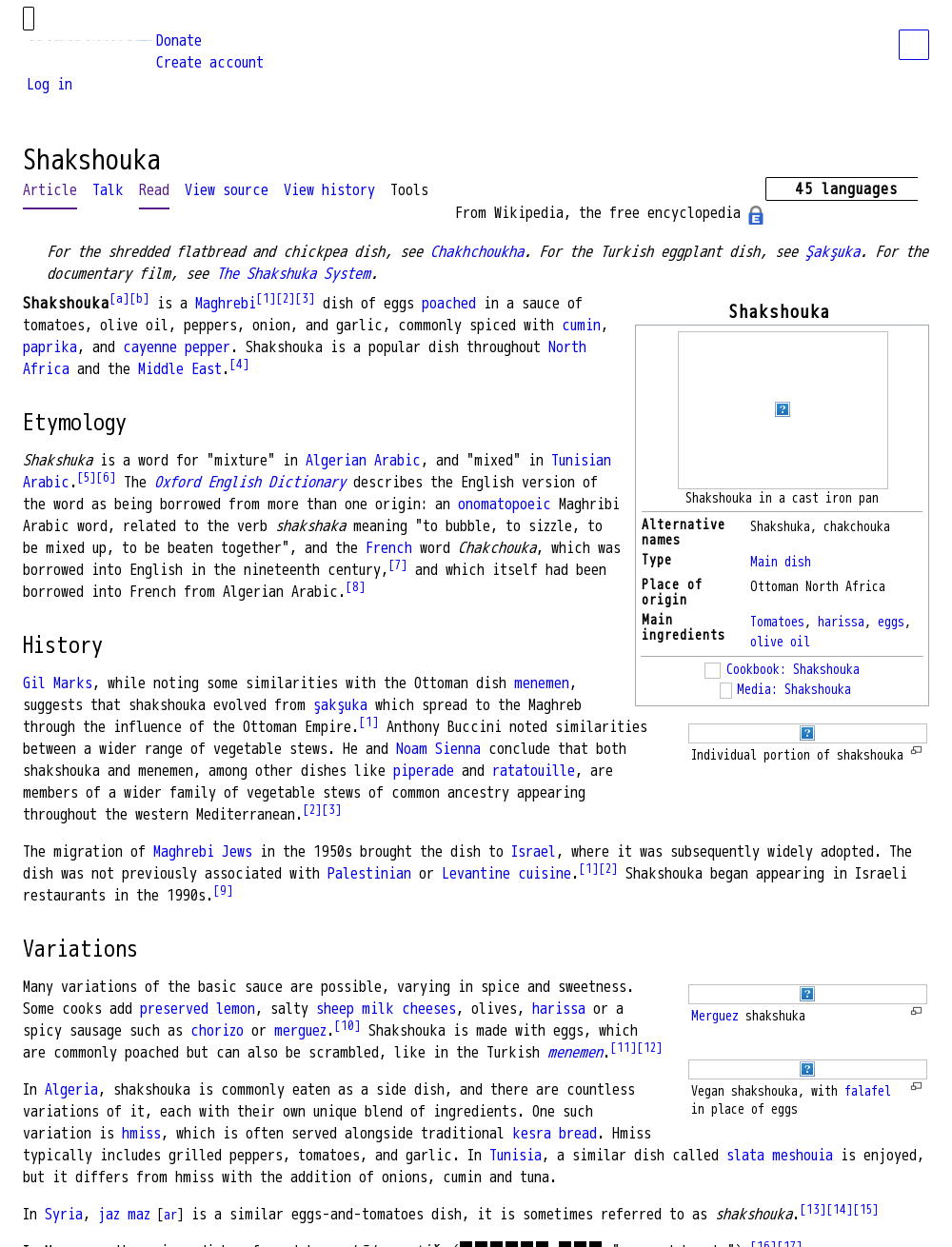
Shakshouka
Shakshouka in a cast iron pan
Alternative
names
Shakshuka, chakchouka
Type
Place of
origin
Ottoman North Africa
Main
ingredients
,
,
,
Individual portion of shakshouka
Shakshouka
is a
dish of eggs
in a sauce of
tomatoes, olive oil, peppers, onion, and garlic, commonly spiced with
,
, and
. Shakshouka is a popular dish throughout
and the
.
Etymology
Shakshuka
is a word for "mixture" in
, and "mixed" in
.
The
describes the English version of
the word as being borrowed from more than one origin: an
Maghribi
Arabic word, related to the verb
shakshaka
meaning "to bubble, to sizzle, to
be mixed up, to be beaten together", and the
word
Chakchouka
, which was
borrowed into English in the nineteenth century,
and which itself had been
borrowed into French from Algerian Arabic.
History
, while noting some similarities with the Ottoman dish
,
suggests that shakshouka evolved from
which spread to the Maghreb
through the influence of the Ottoman Empire.
Anthony Buccini noted similarities
between a wider range of vegetable stews. He and
conclude that both
shakshouka and menemen, among other dishes like
and
, are
members of a wider family of vegetable stews of common ancestry appearing
throughout the western Mediterranean.
The migration of
in the 1950s brought the dish to
, where it was subsequently widely adopted. The
dish was not previously associated with
or
.
Shakshouka began appearing in Israeli
restaurants in the 1990s.
Variations
shakshuka
Vegan shakshouka, with
in place of eggs
Many variations of the basic sauce are possible, varying in spice and sweetness.
Some cooks add
, salty
, olives,
or a
spicy sausage such as
or
.
Shakshouka is made with eggs, which
are commonly poached but can also be scrambled, like in the Turkish
.
In
, shakshouka is commonly eaten as a side dish, and there are countless
variations of it, each with their own unique blend of ingredients. One such
variation is
, which is often served alongside traditional
. Hmiss
typically includes grilled peppers, tomatoes, and garlic. In
, a similar dish called
is enjoyed,
but it differs from hmiss with the addition of onions, cumin and tuna.
In
,
[
]
is a similar
eggs-and-tomatoes dish, it is sometimes referred to as
shakshouka
.
In Morocco, there is a dish referred to as
bīḍ w-maṭiša
(
بيض ومطيشة
"egg and tomato").
In
, the dish features the typical poached eggs in a spiced
-based sauce but with some variations in
ingredients. The base consists of sautéed
,
, and chopped
cooked until softened.
Chopped
tomatoes or tomato paste is then added, along with spices such as
,
, and
.
Once the sauce
thickens, eggs are cracked directly into the mixture and poached until the whites are set but the yolks remain
runny.
It is garnished with fresh herbs like
and
, sometimes also a sprinkle of
.
The dish is commonly eaten with warm
, and is a popular choice for breakfast in the country.
Some variations of shakshouka can be made with
, toasted whole spices, yogurt and fresh herbs.
Spices
can include ground
,
,
,
and
.
Tunisian cooks may add potatoes,
broad beans, artichoke hearts or courgettes to the dish.
The
dish
can be used as a base for
shakshouka.
Because eggs are the main ingredient, it often appears on breakfast menus in English-speaking countries, but in the
Arab world as well as Israel, it is also a popular evening meal,
and, like
and
, is a Levantine
regional favorite.
On the side, pickled vegetables and North African sausage called merguez might be served, or
simply bread, with mint tea.
In Jewish culture, a large batch of tomato stew may be made on Friday for the
dinner and the leftovers used on
Sunday morning to make a breakfast shakshouka with eggs.
In
, the dish is known as
huevos a la
flamenca
; this version includes chorizo and
.
In
, there is a version of this dish called
uova in purgatorio
(eggs in purgatory) that adds garlic, basil or parsley.
See also
, an East Asian dish
Notes
:
شكشوكة
,
:
šakšūkah
also spelled
shakshuka
or
chakchouka
References
^
Gil Marks (2010).
. HMH. p. 1673.
.
^
Sienna, Noam (2021). "Shakshūka for All Seasons: Tunisian Jewish Foodways at the Turn of the Twentieth Century". In Gaul,
Anny; Pitts, Graham Auman;
(eds.).
.
University of Texas Press. pp.
170–
183.
:
.
.
.
^
Buccini, Anthony F. (2006). "Western Mediterranean Vegetable Stews and the Integration of Culinary Exotica". In Hosking,
Richard (ed.).
Authenticity in the Kitchen: Proceedings of the Oxford Symposium on Food and Cookery 2005
. Prospect Books.
pp.
132–
145.
Salah, Maha (14 February 2020).
.
.
).
2010
بن قينة، عمر (
قوة الحق فوق حق القوة
. دار الأمة
،. p. 121.
.
.
Collins English Dictionary
.
.
Oxford English Dictionary
.
Alain Rey (2011).
Dictionnaire Historique de la langue française
. NATHAN, 2011. p. 4220.
.
.
www.britannica.com
. Retrieved
2025-06-09
.
.
The Guardian
. February 18, 2012.
Joel Lurie Grishaver (2008).
Artzeinu: An Israel Encounter
.
^
Gil Marks,
Encyclopedia of Jewish Food
, Houghton Mifflin Harcourt, 2010,
,
s.v.
, p. 547
Atassi, Anas (2 March 2021).
.
. Murdoch Books. p. 52.
.
Retrieved
20 September
2025
.
.
. Retrieved
20 September
2025
.
[This simple dish is
a common dish on tables around the world. What do you call it?].
CNN Arabic
(in Arabic). 27 August 2019
. Retrieved
20 September
2025
.
.
Hespress -
هسبريس جريدة إلكترونية مغربية
(in Arabic). 2012-
10-16
. Retrieved
2022-01-26
.
12
بنعبو, عبد العزيز (
February 2023).
.
^
.
Grand European Travel
. Retrieved
March 16,
2025
.
Gordon, Peter (2018-06-03).
.
The Guardian
.
. Retrieved
2018-07-21
.
.
PBS Food
. 2015-03-12
. Retrieved
2018-07-21
.
Clark, Melissa.
.
NYT Cooking
. Retrieved
2018-07-21
.
Roden, Claudia (1996).
The Book of Jewish Food: An Odyssey from Samarkand to New York
. Knopf. p. 512.
.
Gur, Janna (2014).
Jewish Soul Food: From Minsk to Marrakesh
.
Clifford-Smith, Stephanie (2011-06-07).
.
.
from the original
on 2017-08-08
. Retrieved
2017-08-07
.
Josephs, Bernard (2009-10-08).
.
.
from the
original on 2017-08-08
. Retrieved
2017-08-07
.
Ashkenazi, Michael (2020).
Food Cultures of Israel: Recipes, Customs, and Issues
. p. 89.
Tish, Ben (2019).
. Bloomsbury. p. 46.
.
.
La Cucina italiana
(in Italian). 20 August 2015
. Retrieved
2023-06-24
.
External links
Quotations related to
at Wikiquote
Breads
Entrée (puff pastries, soups and salads)
Dishes
Brochettes
Ingredients
Beverages
Desserts
and pastries
Related
Beverages
Non-alcoholic beverages
Alcoholic beverages
(main article)
(main article)
Breads
Starters
and salads
Cheeses
(main article)
Soups
Dishes
Desserts
Common ingredients
Vegetables
Herbs & spices
Related cuisines
Dishes (
)
[
]
[
]
[
]
[
]
[
]
[
]
Brochettes
Ingredients
Soups
[
]
Breads
[
]
Desserts & pastries
[
]
[
]
Beverages
[
]
Related cuisines
Breads, dishes,
and soups
Ingredients
Beverages
Desserts
and pastries
Related
History
Types
Religious dietary laws
Chefs
Religious foods
Breads
Ashkenazi breads
Sephardic/Mizrahi breads
Ethiopian breads
Pancakes
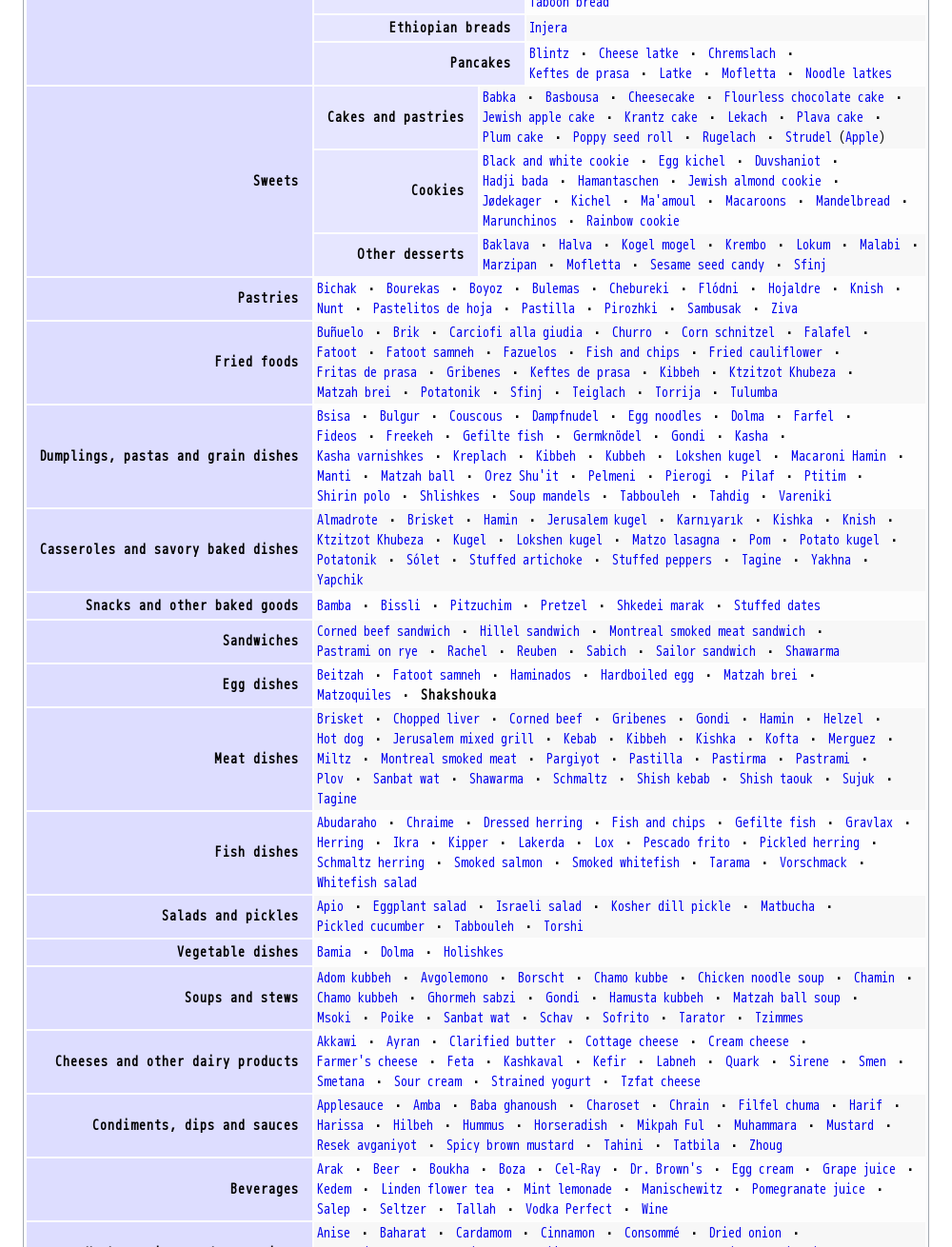
Sweets
Cakes and pastries
Cookies
Other desserts
Pastries
Fried foods
Dumplings, pastas and grain dishes
Casseroles and savory baked dishes
Snacks and other baked goods
Sandwiches
Egg dishes
Meat dishes
Fish dishes
Salads and pickles
Vegetable dishes
Soups and stews
Cheeses and other dairy products
Condiments, dips and sauces
Beverages
Herbs, spices and seasonings
Eateries
Related lists
:
This page was last edited on 24 May 2026, at 20:29
(UTC)
.
Text is available under the
;
additional terms may apply. By using this site, you agree to the
and
. Wikipedia® is a registered trademark of the
, a non-profit organization.