Rumelhart Prize
6 languages
Tools
From Wikipedia, the free encyclopedia
This article
needs additional citations for
.
Please help
by
. Unsourced material may be
challenged and removed.
Find sources:
–
·
·
·
·
(
December
2021
)
(
)
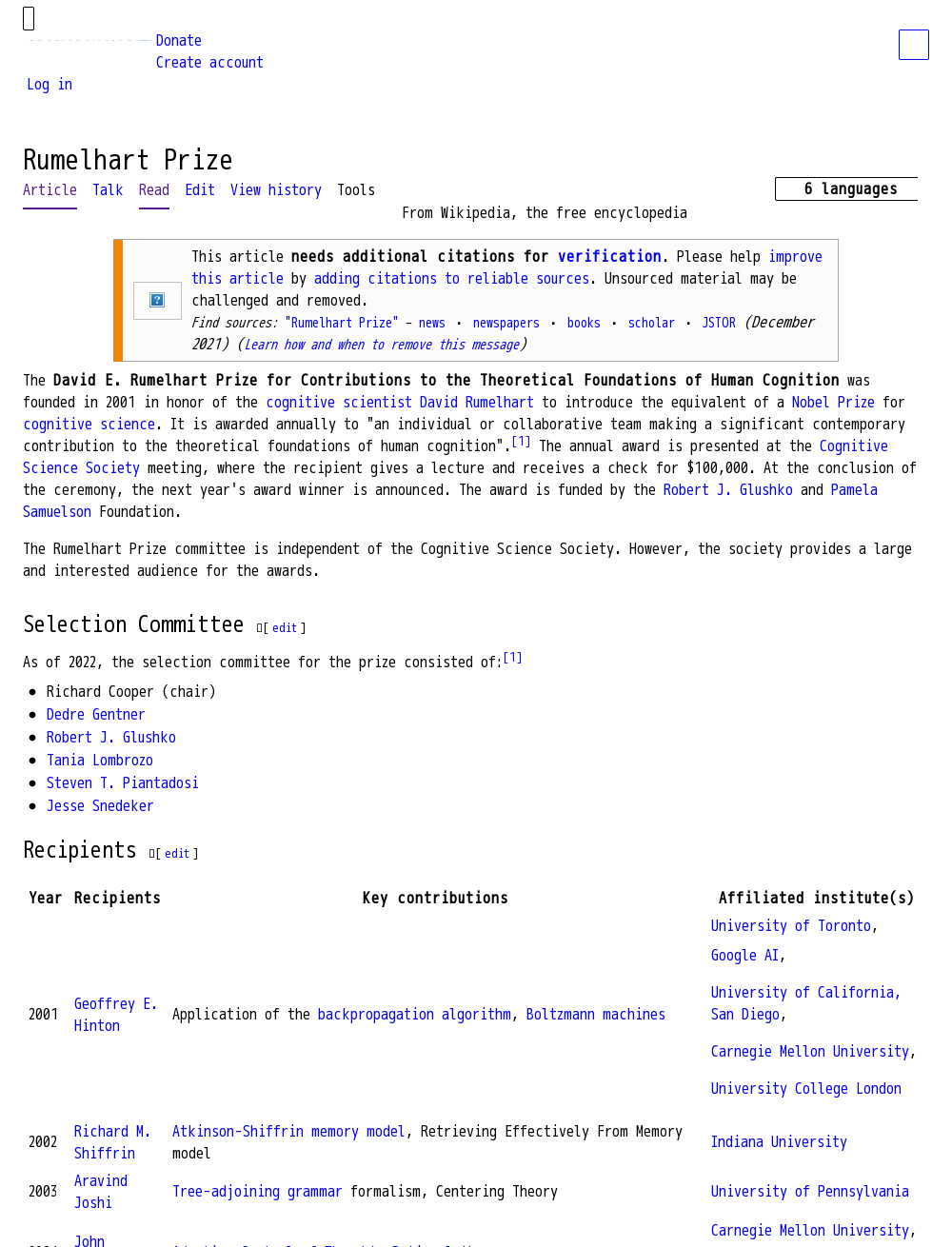
The
David E. Rumelhart Prize for Contributions to the Theoretical Foundations of Human Cognition
was
founded in 2001 in honor of the
to introduce the equivalent of a
for
. It is awarded annually to "an individual or collaborative team making a significant contemporary
contribution to the theoretical foundations of human cognition".
The annual award is presented at the
meeting, where the recipient gives a lecture and receives a check for $100,000. At the conclusion of
the ceremony, the next year's award winner is announced. The award is funded by the
and
Foundation.
The Rumelhart Prize committee is independent of the Cognitive Science Society. However, the society provides a large
and interested audience for the awards.
Selection Committee
[
]
As of 2022, the selection committee for the prize consisted of:
Richard Cooper (chair)
Recipients
[
]
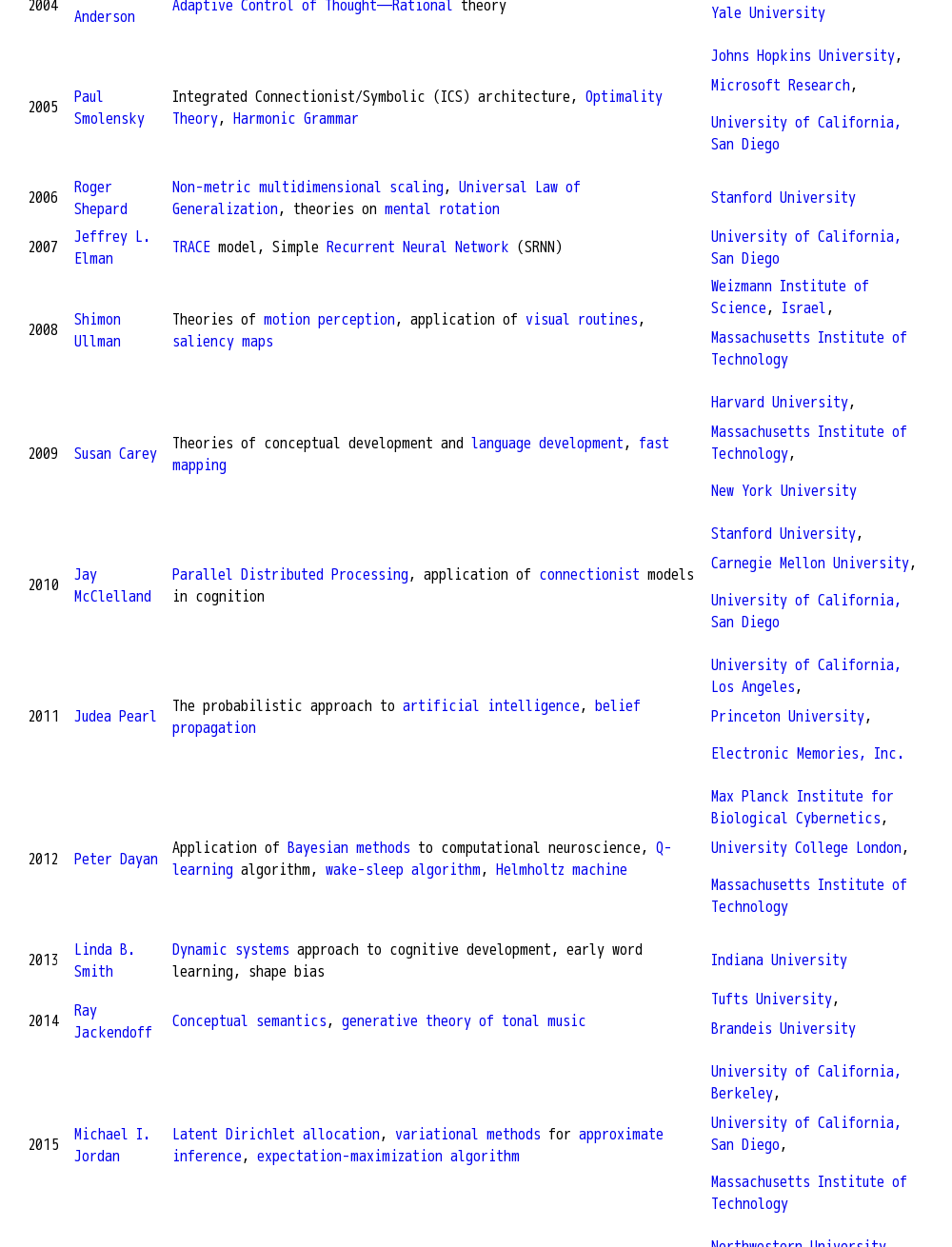
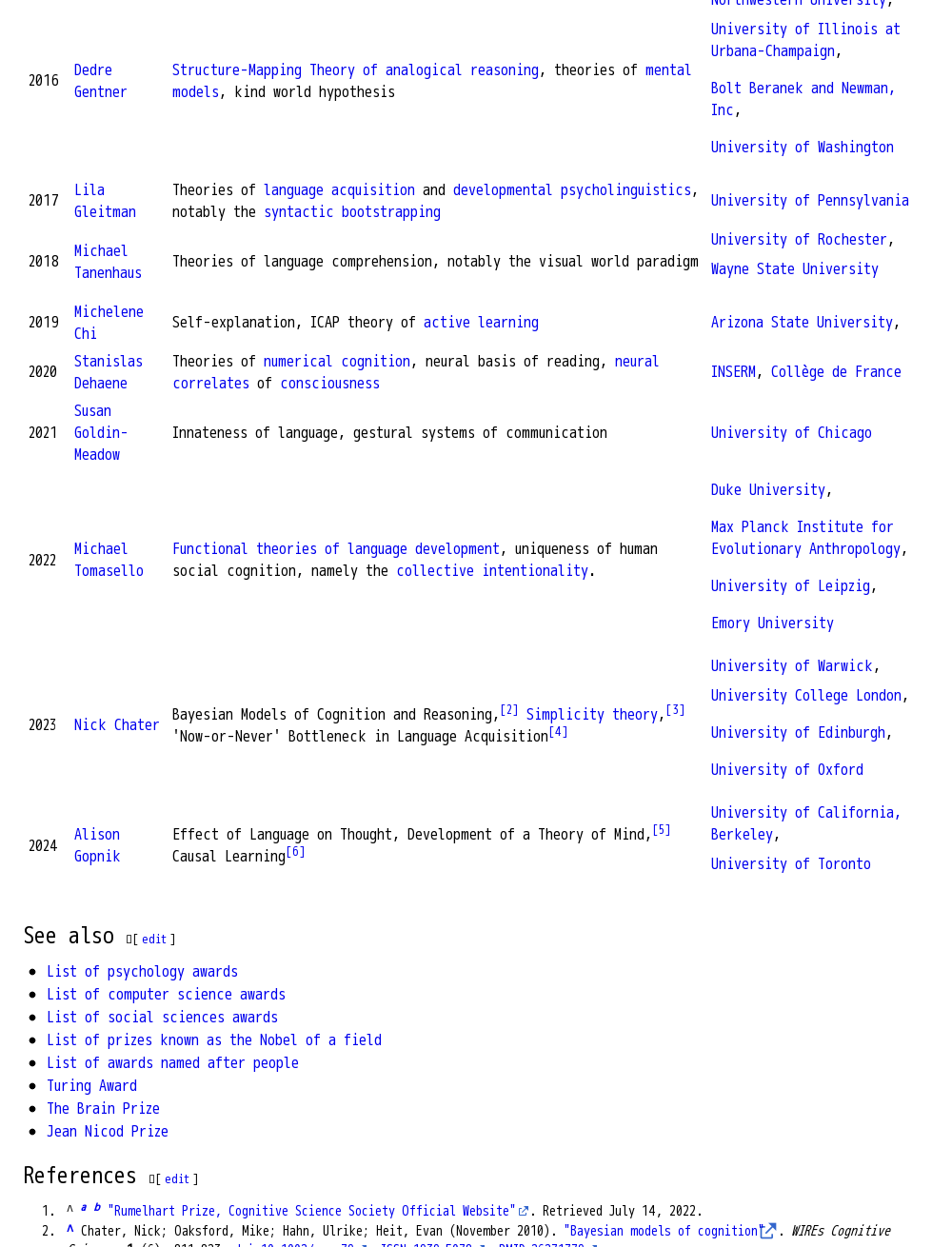
Year
Recipients
Key contributions
Affiliated institute(s)
2001
Application of the
,
,
,
,
,
2002
, Retrieving Effectively From Memory
model
2003
formalism, Centering Theory
2004
theory
,
2005
Integrated Connectionist/Symbolic (ICS) architecture,
,
,
,
2006
,
, theories on
2007
model, Simple
(SRNN)
2008
Theories of
, application of
,
,
,
2009
Theories of conceptual development and
,
,
,
2010
, application of
models
in cognition
,
,
2011
The probabilistic approach to
,
,
,
2012
Application of
to computational neuroscience,
algorithm,
,
,
,
2013
approach to cognitive development, early word
learning, shape bias
2014
,
,
2015
,
for
,
,
,
2016
, theories of
, kind world hypothesis
,
,
,
2017
Theories of
and
,
notably the
2018
Theories of language comprehension, notably the visual world paradigm
,
2019
Self-explanation, ICAP theory of
,
2020
Theories of
, neural basis of reading,
of
,
2021
Innateness of language, gestural systems of communication
2022
, uniqueness of human
social cognition, namely the
.
,
,
,
2023
Bayesian Models of Cognition and Reasoning,
,
'Now-or-Never' Bottleneck in Language Acquisition
,
,
,
2024
Effect of Language on Thought, Development of a Theory of Mind,
Causal Learning
,
See also
[
]
References
[
]
^
. Retrieved
July 14,
2022
.
Chater, Nick; Oaksford, Mike; Hahn, Ulrike; Heit, Evan (November 2010).
.
WIREs Cognitive
Science
.
1
(6):
811–
823.
:
.
.
.
Chater, Nick (April 1999).
.
The Quarterly Journal of
Experimental Psychology Section A
.
52
(2):
273–
302.
:
.
.
Christiansen, Morten H.; Chater, Nick (January 2016).
.
Behavioral and Brain Sciences
.
39
e62.
:
.
.
.
Gopnik, Alison; Meltzoff, Andrew (1998).
Words, thoughts, and theories
. Learning, development, and conceptual change (2.
print ed.). Cambridge, Mass. London: MIT.
.
Buchsbaum, Daphna; Bridgers, Sophie; Skolnick Weisberg, Deena; Gopnik, Alison (August 5, 2012).
.
Philosophical Transactions of the Royal Society B: Biological
Sciences
.
367
(1599):
2202–
2212.
:
.
.
.
.
:
This page was last edited on 24 October 2025, at 21:09
(UTC)
.
Text is available under the
;
additional terms may apply. By using this site, you agree to the
and
. Wikipedia® is a registered trademark of the
, a non-profit organization.