Robert Moog
47 languages
Tools
From Wikipedia, the free encyclopedia
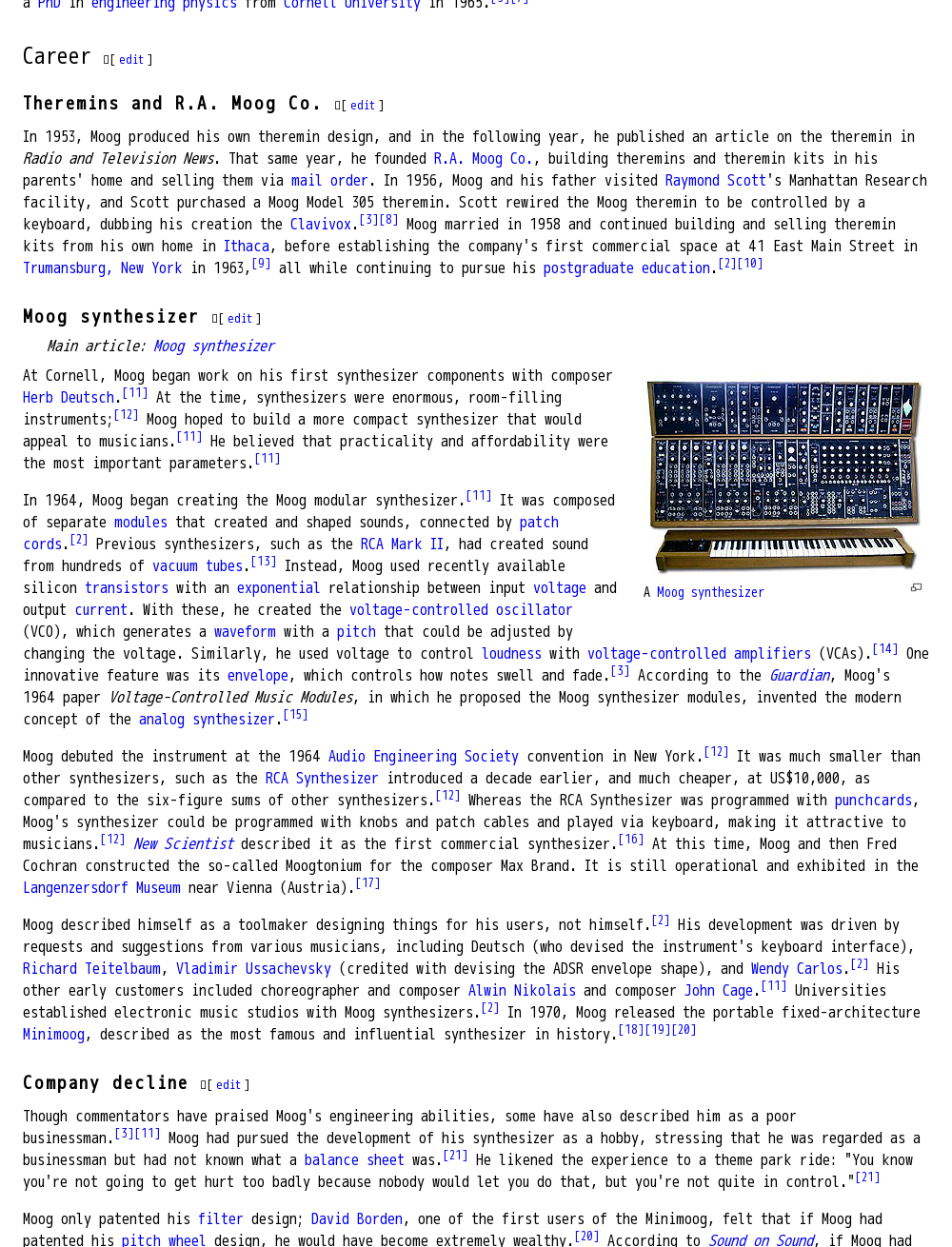
Robert Moog
Born
Robert Arthur Moog
May 23, 1934
, U.S.
Died
August 21, 2005
(aged 71)
,
U.S.
Education
(
)
(BS)
(
)
Occupations
Electronics engineer
inventor
Spouses
Shirley May Leigh
(
m.
1958;
div.
1994)
Ileana Grams
(
m.
1996)
Children
4
Relatives
(aunt)
(cousin)
Robert Arthur Moog
(
; May 23, 1934 – August 21, 2005) was an
American electronics engineer and
pioneer. He was the
founder of the synthesizer manufacturer
and the inventor of the
first commercial
, the
, which debuted in 1964. In
1970, Moog released a more portable model, the
, described as the
most famous and influential synthesizer in history. Among Moog's honors are a
, received in 2002, and an induction into the
.
By 1963, Moog had been designing and selling
for several years while
working toward a PhD in engineering physics at
. He
developed his synthesizer in response to demand for more practical and
affordable electronic-music equipment, guided by suggestions and requests from
composers. Moog's principal innovation was the
,
which uses
to control
. He also introduced fundamental
synthesizer concepts such as
,
and the
. He is credited with introducing synthesizers to a wider audience and
influencing the development of
.
Moog pursued his work as a hobby, and he is regarded as a poor businessman.
His only
was on his
design; commentators have
speculated that he would have become extremely wealthy had he patented his
other innovations, but that their availability in the
helped the
synthesizer industry flourish.
In 1971, Moog sold Moog Music to
, where he remained
as a designer until 1977. In 1978, he founded the company Big Briar, and in
2002 he renamed it Moog Music after reacquiring the rights to the name. In
later years, Moog taught at the
and
continued designing instruments for the revived Moog Music. He died at the age
of 71 in
from a brain tumor.
Early life and education
[
]
Robert Moog was born at
in New York City on May 23, 1934. His father was George Conrad Moog, of
German descent. His mother was Shirley (Jacobs) Moog, of Polish-Jewish descent.
He was raised in
,
.
When he was a boy, Moog's mother forced him to study the piano. He was active in the
, and especially
enjoyed spending time with his father, a
, visiting
's
and working on
and
projects.
He became fascinated by the
, an
controlled by moving
the hands over
. In 1949, at the age of 14, he built a theremin from plans printed in
.
He graduated from the
in 1952.
He earned a
in
from
of the
in 1955, and a
in
from the
under a
in 1957.
He earned
a
in
from
in 1965.
Career
[
]
Theremins and R.A. Moog Co.
[
]
In 1953, Moog produced his own theremin design, and in the following year, he published an article on the theremin in
Radio and Television News
. That same year, he founded
, building theremins and theremin kits in his
parents' home and selling them via
. In 1956, Moog and his father visited
's Manhattan Research
facility, and Scott purchased a Moog Model 305 theremin. Scott rewired the Moog theremin to be controlled by a
keyboard, dubbing his creation the
.
Moog married in 1958 and continued building and selling theremin
kits from his own home in
, before establishing the company's first commercial space at 41 East Main Street in
in 1963,
all while continuing to pursue his
.
Moog synthesizer
[
]
Main article:
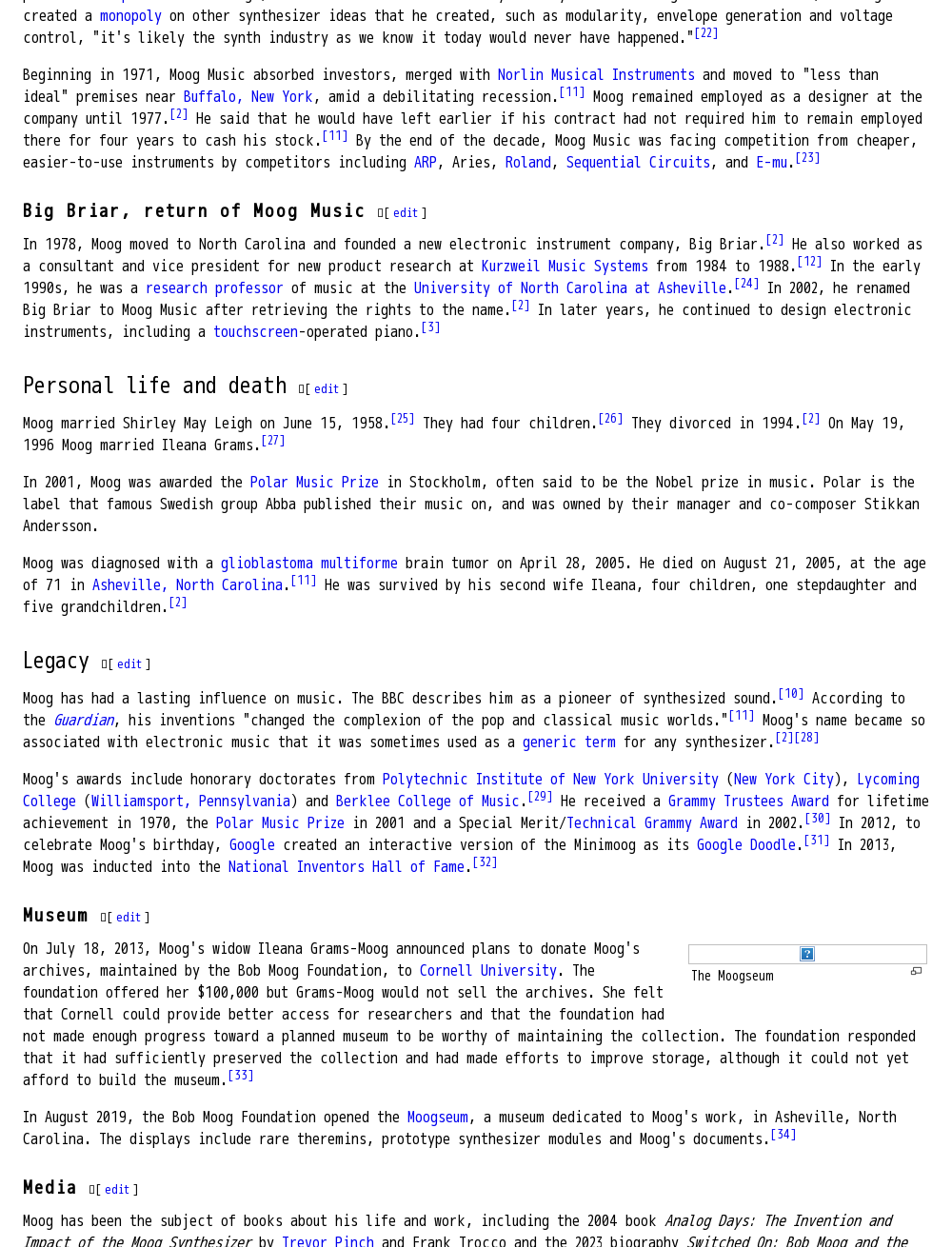
A
At Cornell, Moog began work on his first synthesizer components with composer
.
At the time, synthesizers were enormous, room-filling
instruments;
Moog hoped to build a more compact synthesizer that would
appeal to musicians.
He believed that practicality and affordability were
the most important parameters.
In 1964, Moog began creating the Moog modular synthesizer.
It was composed
of separate
that created and shaped sounds, connected by
.
Previous synthesizers, such as the
, had created sound
from hundreds of
.
Instead, Moog used recently available
silicon
with an
relationship between input
and
output
. With these, he created the
(VCO), which generates a
with a
that could be adjusted by
changing the voltage. Similarly, he used voltage to control
with
(VCAs).
One
innovative feature was its
, which controls how notes swell and fade.
According to the
, Moog's
1964 paper
Voltage-Controlled Music Modules
, in which he proposed the Moog synthesizer modules, invented the modern
concept of the
.
Moog debuted the instrument at the 1964
convention in New York.
It was much smaller than
other synthesizers, such as the
introduced a decade earlier, and much cheaper, at US$10,000, as
compared to the six-figure sums of other synthesizers.
Whereas the RCA Synthesizer was programmed with
,
Moog's synthesizer could be programmed with knobs and patch cables and played via keyboard, making it attractive to
musicians.
described it as the first commercial synthesizer.
At this time, Moog and then Fred
Cochran constructed the so-called Moogtonium for the composer Max Brand. It is still operational and exhibited in the
near Vienna (Austria).
Moog described himself as a toolmaker designing things for his users, not himself.
His development was driven by
requests and suggestions from various musicians, including Deutsch (who devised the instrument's keyboard interface),
,
(credited with devising the ADSR envelope shape), and
.
His
other early customers included choreographer and composer
and composer
.
Universities
established electronic music studios with Moog synthesizers.
In 1970, Moog released the portable fixed-architecture
, described as the most famous and influential synthesizer in history.
Company decline
[
]
Though commentators have praised Moog's engineering abilities, some have also described him as a poor
businessman.
Moog had pursued the development of his synthesizer as a hobby, stressing that he was regarded as a
businessman but had not known what a
was.
He likened the experience to a theme park ride: "You know
you're not going to get hurt too badly because nobody would let you do that, but you're not quite in control."
Moog only patented his
design;
, one of the first users of the Minimoog, felt that if Moog had
patented his
design, he would have become extremely wealthy.
According to
, if Moog had
created a
on other synthesizer ideas that he created, such as modularity, envelope generation and voltage
control, "it's likely the synth industry as we know it today would never have happened."
Beginning in 1971, Moog Music absorbed investors, merged with
and moved to "less than
ideal" premises near
, amid a debilitating recession.
Moog remained employed as a designer at the
company until 1977.
He said that he would have left earlier if his contract had not required him to remain employed
there for four years to cash his stock.
By the end of the decade, Moog Music was facing competition from cheaper,
easier-to-use instruments by competitors including
, Aries,
,
, and
.
Big Briar, return of Moog Music
[
]
In 1978, Moog moved to North Carolina and founded a new electronic instrument company, Big Briar.
He also worked as
a consultant and vice president for new product research at
from 1984 to 1988.
In the early
1990s, he was a
of music at the
.
In 2002, he renamed
Big Briar to Moog Music after retrieving the rights to the name.
In later years, he continued to design electronic
instruments, including a
-operated piano.
Personal life and death
[
]
Moog married Shirley May Leigh on June 15, 1958.
They had four children.
They divorced in 1994.
On May 19,
1996 Moog married Ileana Grams.
In 2001, Moog was awarded the
in Stockholm, often said to be the Nobel prize in music. Polar is the
label that famous Swedish group Abba published their music on, and was owned by their manager and co-composer Stikkan
Andersson.
Moog was diagnosed with a
brain tumor on April 28, 2005. He died on August 21, 2005, at the age
of 71 in
.
He was survived by his second wife Ileana, four children, one stepdaughter and
five grandchildren.
Legacy
[
]
Moog has had a lasting influence on music. The BBC describes him as a pioneer of synthesized sound.
According to
the
, his inventions "changed the complexion of the pop and classical music worlds."
Moog's name became so
associated with electronic music that it was sometimes used as a
for any synthesizer.
Moog's awards include honorary doctorates from
(
),
(
) and
.
He received a
for lifetime
achievement in 1970, the
in 2001 and a Special Merit/
in 2002.
In 2012, to
celebrate Moog's birthday,
created an interactive version of the Minimoog as its
.
In 2013,
Moog was inducted into the
.
Museum
[
]
The Moogseum
On July 18, 2013, Moog's widow Ileana Grams-Moog announced plans to donate Moog's
archives, maintained by the Bob Moog Foundation, to
. The
foundation offered her $100,000 but Grams-Moog would not sell the archives. She felt
that Cornell could provide better access for researchers and that the foundation had
not made enough progress toward a planned museum to be worthy of maintaining the collection. The foundation responded
that it had sufficiently preserved the collection and had made efforts to improve storage, although it could not yet
afford to build the museum.
In August 2019, the Bob Moog Foundation opened the
, a museum dedicated to Moog's work, in Asheville, North
Carolina. The displays include rare theremins, prototype synthesizer modules and Moog's documents.
Media
[
]
Moog has been the subject of books about his life and work, including the 2004 book
Analog Days: The Invention and
Impact of the Moog Synthesizer
by
and Frank Trocco and the 2023 biography
Switched On: Bob Moog and the
Synthesizer Revolution
by
. Moog had contributed the foreword to Glinsky's first book,
Theremin: Ether
Music and Espionage,
about
, who was a principal inspiration to Moog.
Moog was also the subject of
, a 2004 documentary directed by
, who said that Moog "embodies the
archetypal American maverick inventor."
References
[
]
Glinsky, Albert (2022).
Switched On: Bob Moog and the Synthesizer Revolution
. New York City, New York, US: Oxford University
Press. p. 4.
.
^
Kozinn, Allan (August 23, 2005).
.
New York
Times
. Retrieved
December 3,
2018
.
^
Bernstein, Adam (August 23, 2005).
.
.
. Retrieved
December 3,
2018
.
Trangle, Sarina (May 30, 2012).
.
The Riverdale Press
.
from the original on March 3, 2018
.
Retrieved
March 3,
2018
.
In honor of what would've been Robert Moog's 78th birthday, the Bronx High School of Science started
its day with a tribute to the 1952 alumnus who began pioneering the synthesizer in high school.
. Audio Engineering Society. 1986.
. Oxford University Press. 2022.
.
.
nndb.com
. Retrieved
February 15,
2015
.
Glinsky, Albert (2022).
Switched On: Bob Moog and the Synthesizer Revolution
. New York City, New York, US: Oxford University
Press. pp.
32–
33.
.
Glinsky, Albert (2022).
Switched On: Bob Moog and the Synthesizer Revolution
. New York City, New York, US: Oxford University
Press. p. 61.
.
^
.
. August 22, 2005
. Retrieved
December 3,
2018
.
^
Stearns, David Patrick (August 25, 2005).
.
the Guardian
. Retrieved
December 3,
2018
.
^
.
Wired
. Retrieved
December 3,
2017
.
McNamee, David (August 10, 2010).
.
. Retrieved
October 12,
2018
.
Pinch, Trevor; Trocco, Frank (2004).
Analog Days: The Invention and Impact of the Moog Synthesizer
.
.
.
McNamee, David (August 10, 2010).
.
. Retrieved
October 12,
2018
.
Hamer, Mick.
.
New Scientist
. Retrieved
December 3,
2018
.
(in German)
. Retrieved
August 14,
2025
.
.
WIRED
. Retrieved
November 28,
2018
.
Pinch, Trevor; Trocco, Frank (June 30, 2009).
. Harvard
University Press.
.
^
.
daily.redbullmusicacademy.com
. Retrieved
November 28,
2018
.
^
Pinch, Trevor; Trocco, Frank (2004).
Analog Days: The Invention and Impact of the Moog Synthesizer
.
.
.
Leon, Richard (October 2003).
.
Sound On Sound
. Retrieved
April 1,
2024
.
^
Kozinn, Allan (August 23, 2005).
.
The New York Times
.
Retrieved
December 3,
2018
.
. Obituaries.
Variety
.
400
(2): 85. August 29, 2005 – via EBSCOhost.
Glinsky, Albert (2022).
Switched On: Bob Moog and the Synthesizer Revolution
. New York City, New York, US: Oxford University
Press. pp.
37–
42.
.
Glinsky, Albert (2022).
Switched On: Bob Moog and the Synthesizer Revolution
. New York City, New York, US: Oxford University
Press. pp.
54–
198.
.
Glinsky, Albert (2022).
Switched On: Bob Moog and the Synthesizer Revolution
. New York City, New York, US: Oxford University
Press. p. 356.
.
.
genericides.org
. April 12, 2020
. Retrieved
January 28,
2021
.
[
]
Pinch, Trevor (2002).
(1 ed.). Cambridge, Massachusetts:
Harvard University Press. pp.
.
.
Polar Music Prize
. Retrieved
March 4,
2017
.
.
WIRED
. Retrieved
November 28,
2018
.
"Moog Inducted into Inventors Hall of Fame".
School Band & Orchestra
.
16
(5): 10. May 2013.
.
Frankel, Jake (August 12, 2013).
.
. Retrieved
August 15,
2013
.
Deahl, Dani (May 26, 2019).
.
The Verge
.
Retrieved
November 16,
2019
.
Glinsky, Albert (2022).
Switched On: Bob Moog and the Synthesizer Revolution
. New York City, New York, US: Oxford University
Press.
.
External links
[
]
Wikiquote has quotations
related to
.
— official website
discography at
illustrated history of company and products
at
Synthesizers
Keytars
Software
Effects units
Guitars
People
and
Techniques
By country
Active
organizations
Studio
studio
Inactive
organizations
Laureates of the
/ the
(1992)
/
(1993)
/
(1994)
/
(1995)
/
(1996)
/
(1997)
/
(1998)
/
(1999)
/
(2000)
/
/
(2001)
/
(2002)
(2003)
/
(2004)
/
(2005)
/
(2006)
/
(2007)
/
(2008)
/
/
(2009)
/
(2010)
/
(2011)
/
(2012)
/
(2013)
/
(2014)
/
(2015)
/
(2016)
/
(2017)
/
(2018)
/
/
(2019)
/
(2020)
/
(2022)
/
/
(2023)
/
(2024)
/
/
(2025)
(1987)
(1988)
(1989)
(1990)
(1991)
(1993)
(1994)
(1995)
(1996)
(1997)
(1998)
(1999)
(2000)
(2001)
(2002)
(2003)
(2004)
(2005)
(2006)
(2007)
(2008)
(2009)
(2010)
(2011)
(2012)
(2013)
(2014)
(2015)
(2016)
(2017)
Scott A. Wyatt (2018)
(2019)
(2020)
International
National
Artists
People
Other
:
This page was last edited on 27 May 2026, at 17:09
(UTC)
.
Text is available under the
;
additional terms may apply. By using this site, you agree to the
and
. Wikipedia® is a registered trademark of the
, a non-profit organization.