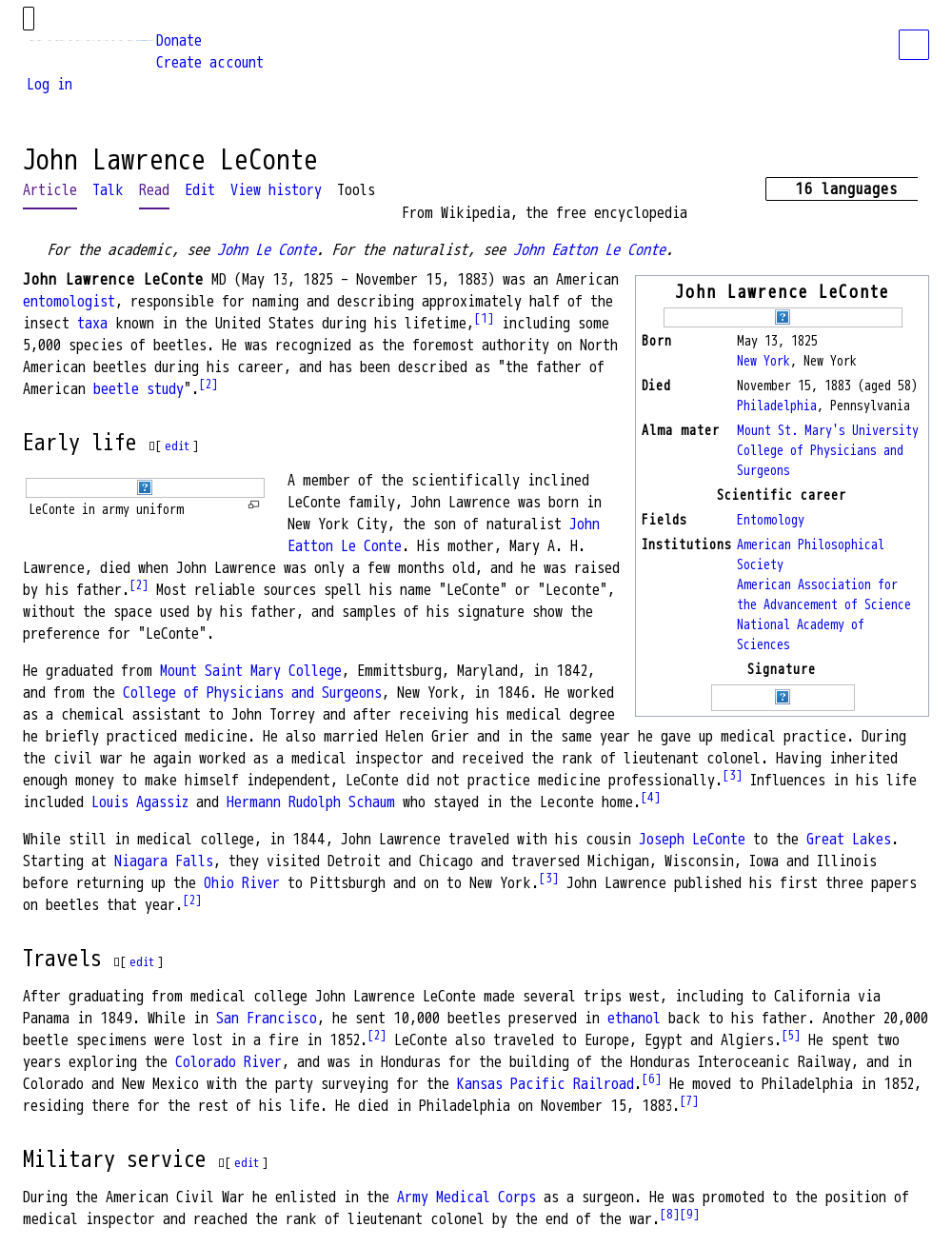
John Lawrence LeConte
16 languages
Tools
From Wikipedia, the free encyclopedia
For the academic, see
. For the naturalist, see
.
John Lawrence LeConte
Born
May 13, 1825
, New York
Died
November 15, 1883
(aged 58)
, Pennsylvania
Alma mater
Scientific career
Fields
Institutions
Signature
John Lawrence LeConte
MD (May 13, 1825 – November 15, 1883) was an American
, responsible for naming and describing approximately half of the
insect
known in the United States during his lifetime,
including some
5,000 species of beetles. He was recognized as the foremost authority on North
American beetles during his career, and has been described as "the father of
American
".
Early life
[
]
LeConte in army uniform
A member of the scientifically inclined
LeConte family, John Lawrence was born in
New York City, the son of naturalist
. His mother, Mary A. H.
Lawrence, died when John Lawrence was only a few months old, and he was raised
by his father.
Most reliable sources spell his name "LeConte" or "Leconte",
without the space used by his father, and samples of his signature show the
preference for "LeConte".
He graduated from
, Emmittsburg, Maryland, in 1842,
and from the
, New York, in 1846. He worked
as a chemical assistant to John Torrey and after receiving his medical degree
he briefly practiced medicine. He also married Helen Grier and in the same year he gave up medical practice.
During
the civil war he again worked as a medical inspector and received the rank of lieutenant colonel. Having inherited
enough money to make himself independent, LeConte did not practice medicine professionally.
Influences in his life
included
and
who stayed in the Leconte home.
While still in medical college, in 1844, John Lawrence traveled with his cousin
to the
.
Starting at
, they visited Detroit and Chicago and traversed Michigan, Wisconsin, Iowa and Illinois
before returning up the
to Pittsburgh and on to New York.
John Lawrence published his first three papers
on beetles that year.
Travels
[
]
After graduating from medical college John Lawrence LeConte made several trips west, including to California via
Panama in 1849. While in
, he sent 10,000 beetles preserved in
back to his father. Another 20,000
beetle specimens were lost in a fire in 1852.
LeConte also traveled to Europe, Egypt and Algiers.
He spent two
years exploring the
, and was in Honduras for the building of the Honduras Interoceanic Railway, and in
Colorado and New Mexico with the party surveying for the
.
He moved to Philadelphia in 1852,
residing there for the rest of his life. He died in Philadelphia on November 15, 1883.
Military service
[
]
During the American Civil War he enlisted in the
as a surgeon. He was promoted to the position of
medical inspector and reached the rank of lieutenant colonel by the end of the war.
U.S. Mint
[
]
In 1878 he became the chief clerk (assistant director) of the
in Philadelphia. He retained that
position until his death in 1883.
Scientific societies
[
]
LeConte was active in the scientific societies of his time, with stints as vice-president of the
(1880–1883) and president of the
(1873). He
was a founder of the
, and a charter member of the
.
Legacy
[
]
LeConte's gravemarker,
,
,
The genera
,
,
, and
and several hundred
species (mostly beetles) are named after him, including a bird,
(
Toxostoma lecontei
), which he discovered while on a beetle-collecting trip to
, and was named after him by
. LeConte communicated
with and collected birds and other natural history specimens for
, a distant cousin and assistant director and then director of the
for a total of 39
years. In turn Baird asked other naturalists to collect beetles for LeConte.
In the 1850s, LeConte collected some crystals from a cave in Honduras being mined for bat guano.
It was later found to
be a new mineral that was named "
" in his honor.
Works
[
]
English
has
original works by or about:
;
;
(1853).
. Washington: Smithsonian
Institution.
Catalogue of the Coleoptera of the United States.
(1853)
,
revised by
and John Lawrence LeConte
Classification of the Coleoptera of North America
(1861, 1873)
New Species of North American Coleoptera
(1866, 1873)
;
(December 1876).
.
.
15
(96):
iii–
xvi,
1–
455.
Classification of the Coleoptera of North America. Part II
(1883) - with
Taxa described by him
[
]
See
Notes
[
]
^
2001-05-20 at the
- URL retrieved September 14, 2006
^
Evans, Arthur V., and James N. Hogue. 2004. Chapter 1: A Brief History of Beetle Study in California.
Introduction to
California Beetles
. University of California Press.
, as excerpted at
2006-09-04 at the
- URL retrieved September 16, 2006
^
June Drenning Holmquist, ed. (1951).
(PDF)
.
Minnesota
History
.
32
(2):
81–
99.
.
.
The Coleopterists Bulletin
.
1
(4/5):
46–
48. 1947.
.
.
Scudder, Samuel H. (1884). "A Biographical Sketch of Dr. John Lawrence LeConte".
Transactions of the American Entomological
Society
.
11
(
3–
4):
i–
xxviii.
.
American Scientific Exploration: 1803-1860
. American Philosophical Society Library Publication.
.
1991.
.
.
Delaware State Journal
. November 22, 1883. p. 4
. Retrieved
January 6,
2021
– via Newspapers.com.
, p. 681.
, p. 246.
Beolens, Bo; Watkins, Michael; Grayson, Michael (2011).
The Eponym Dictionary of Reptiles
. Baltimore: Johns Hopkins University
Press. xiii + 296 pp.
. ("Le Conte", page 154).
Taylor, W. J. (1858).
(PDF)
.
American Journal of Science and Arts
.
76
:
273–
274
. Retrieved
May 2,
2021
.
References
[
]
Dow, R. P. (1914). "The Greatest Coleopterist".
Journal of the New York Entomological Society
.
22
(3):
185–
191.
.
Essig, E. O. (1931).
. MacMillan Company. pp.
–685.
Horn, George H. (1883).
.
Science
.
2
(46):
783–
786.
:
.
:
.
.
Mallis, Arnold (1971).
. Rutgers University Press. pp.
.
.
Riley, Charles Valentine (1883).
.
Psyche: A Journal of
Entomology
.
4
(
115–
116):
107–
110.
:
.
Scudder, Samuel H. (1886). "Memoir of John Lawrence LeConte 1825-1883".
Biographical Memoirs
. National Academy of
Sciences:
261–
293.
Sorensen, W. Conner (1995).
Brethren of the Net, American Entomology, 1840-1880
. University of Alabama Press.
"John Lawrence LeConte" (1936).
Dictionary of American Biography
, Charles Scribner's Sons.
.
American Philosophical Society Library
.
External links
[
]
Media related to
at Wikimedia Commons
Samuel Henshaw (1878)
.:Dimmock's special bibliography. no. 1
Cambridge, Massachusetts, The editor (George Dimmock), 1878.
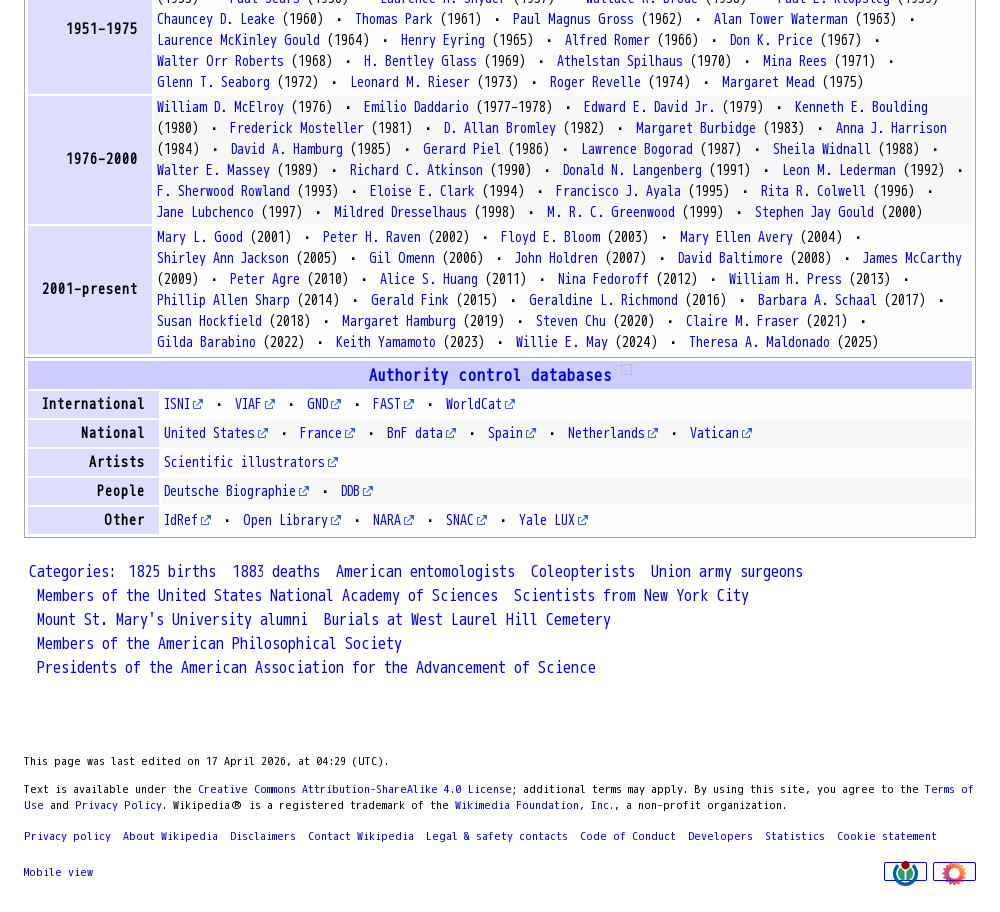
of the
1848–1875
(1848)
(1849)
(1850)
(1851)
(1852)
(1854)
(1855)
(1856)
(1857)
(1857)
(1858)
(1859)
(1860)
(1866)
(1867)
(1868)
(1869)
(1870)
(1870)
(1871)
(1872)
(1873)
(1874)
(1875)
1876–1900
(1876)
(1877)
(1878)
(1879)
(1880)
(1881)
(1882)
(1883)
(1884)
(1885)
(1886)
(1887)
(1888)
(1889)
(1890)
(1891)
(1892)
(1893)
(1894)
(1895)
(1896)
(1896)
(1897)
(1897)
(1898)
(1899)
(1899)
(1899)
(1900)
1901–1925
(1901)
(1902)
(1902)
(1903)
(1904)
(1905)
(1906)
(1907)
(1908)
(1909)
(1910)
(1911)
(1912)
(1913)
(1914)
(1915)
(1916)
(1917)
(1918)
(1919)
(1920)
(1921)
(1922)
(1923)
(1924)
(1925)
1926–1950
(1926)
(1927)
(1928)
(1929)
(1930)
(1931)
(1932)
(1933)
(1934)
(1935)
(1936)
(1937)
(1938)
(1939)
(1940)
(1941)
(1942)
(1943)
(1944)
(1945)
(1946)
(1947)
(1948)
(1949)
(1950)
1951–1975
(1951)
(1952)
(1953)
(1954)
(1955)
(1956)
(1957)
(1958)
(1959)
(1960)
(1961)
(1962)
(1963)
(1964)
(1965)
(1966)
(1967)
(1968)
(1969)
(1970)
(1971)
(1972)
(1973)
(1974)
(1975)
1976–2000
(1976)
(1977–1978)
(1979)
(1980)
(1981)
(1982)
(1983)
(1984)
(1985)
(1986)
(1987)
(1988)
(1989)
(1990)
(1991)
(1992)
(1993)
(1994)
(1995)
(1996)
(1997)
(1998)
(1999)
(2000)
2001–present
(2001)
(2002)
(2003)
(2004)
(2005)
(2006)
(2007)
(2008)
(2009)
(2010)
(2011)
(2012)
(2013)
(2014)
(2015)
(2016)
(2017)
(2018)
(2019)
(2020)
(2021)
(2022)
(2023)
(2024)
(2025)
International
National
Artists
People
Other
:
This page was last edited on 17 April 2026, at 04:29
(UTC)
.
Text is available under the
;
additional terms may apply. By using this site, you agree to the
and
. Wikipedia® is a registered trademark of the
, a non-profit organization.