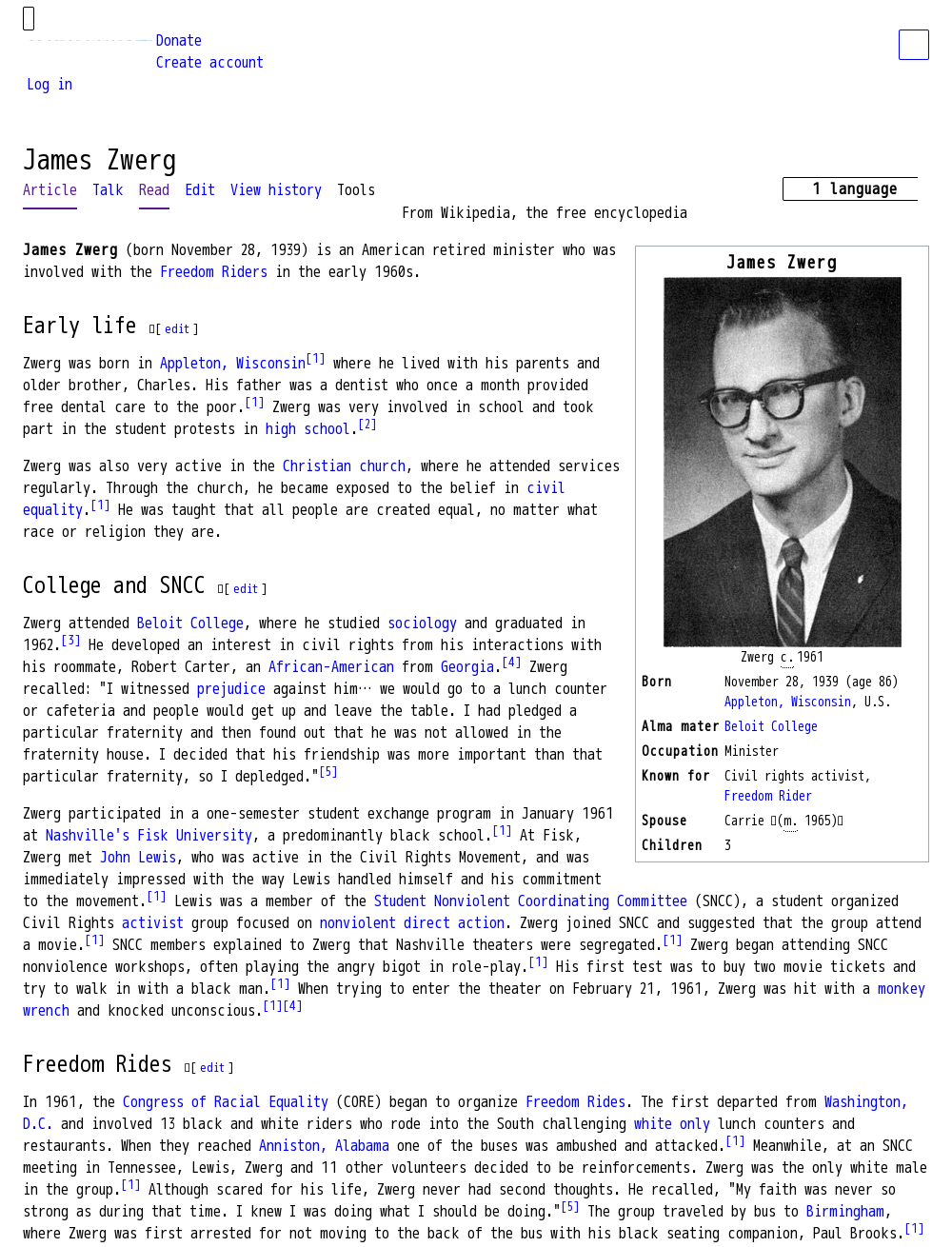
James Zwerg
1 language
Tools
From Wikipedia, the free encyclopedia
James Zwerg
Zwerg
c.
1961
Born
November 28, 1939
(age 86)
, U.S.
Alma mater
Occupation
Minister
Known for
Civil rights activist,
Spouse
Carrie
(
m.
1965)
Children
3
James Zwerg
(born November 28, 1939) is an American retired minister who was
involved with the
in the early 1960s.
Early life
[
]
Zwerg was born in
where he lived with his parents and
older brother, Charles. His father was a dentist who once a month provided
free dental care to the poor.
Zwerg was very involved in school and took
part in the student protests in
.
Zwerg was also very active in the
, where he attended services
regularly. Through the church, he became exposed to the belief in
.
He was taught that all people are created equal, no matter what
race or religion they are.
College and SNCC
[
]
Zwerg attended
, where he studied
and graduated in
1962.
He developed an interest in civil rights from his interactions with
his roommate, Robert Carter, an
from
.
Zwerg
recalled: "I witnessed
against him… we would go to a lunch counter
or cafeteria and people would get up and leave the table. I had pledged a
particular fraternity and then found out that he was not allowed in the
fraternity house. I decided that his friendship was more important than that
particular fraternity, so I depledged."
Zwerg participated in a one-semester student exchange program in January 1961
at
, a predominantly black school.
At Fisk,
Zwerg met
, who was active in the Civil Rights Movement, and was
immediately impressed with the way Lewis handled himself and his commitment
to the movement.
Lewis was a member of the
(SNCC), a student organized
Civil Rights
group focused on
. Zwerg joined SNCC and suggested that the group attend
a movie.
SNCC members explained to Zwerg that Nashville theaters were segregated.
Zwerg began attending SNCC
nonviolence workshops, often playing the angry bigot in role-play.
His first test was to buy two movie tickets and
try to walk in with a black man.
When trying to enter the theater on February 21, 1961, Zwerg was hit with a
and knocked unconscious.
Freedom Rides
[
]
In 1961, the
(CORE) began to organize
. The first departed from
and involved 13 black and white riders who rode into the South challenging
lunch counters and
restaurants. When they reached
one of the buses was ambushed and attacked.
Meanwhile, at an SNCC
meeting in Tennessee, Lewis, Zwerg and 11 other volunteers decided to be reinforcements. Zwerg was the only white male
in the group.
Although scared for his life, Zwerg never had second thoughts. He recalled, "My faith was never so
strong as during that time. I knew I was doing what I should be doing."
The group traveled by bus to
,
where Zwerg was first arrested for not moving to the back of the bus with his black seating companion, Paul Brooks.
Three days later, the riders regrouped and headed to
.
At first the
there was an eerie quiet,
but the scene turned into an
, with the riders attacked from all directions. "Mr. Zwerg was hit with his own
suitcase in the face. Then he was knocked down and a group pummeled him" (qtd. in Loory 577). The prostrate activist
was beaten into unconsciousness somewhere around the time a man took Zwerg's head between his knees while others took
turns pounding and clawing at his face. At one point while Zwerg was unconscious, three men held him up while a woman
kicked him in the groin. After it seemed that the worst of the onslaught was over, Zwerg gained semi-consciousness and
tried to use the handrails to the loading platform to pull himself to his feet. As he struggled to get upright, a white
man came and threw Zwerg over the rail. He crashed to the ground below, landing on his head. He was only the first to
be beaten that day, but the attack on him may have been the most ruthless (Loory 573–79).
Zwerg recalls, "There was
nothing particularly heroic in what I did. If you want to talk about heroism, consider the black man who probably
saved my life. This man in coveralls, just off of work, happened to walk by as my beating was going on and said 'Stop
beating that kid. If you want to beat someone, beat me.' And they did. He was still unconscious when I left the
hospital. I don't know if he lived or died."
Zwerg was denied prompt medical attention because there were no white ambulances available. He was quoted as saying "I
suppose a person has to be dead before anyone will call an ambulance in Montgomery," as he lay in the hospital bed
after being brutally beaten.
He remained unconscious for two days and stayed in the hospital for five days. His
post-riot photos were published in many newspapers and magazines across the country.
After his beating, Zwerg
claimed he had had an incredible religious experience and God helped him to not fight back.
In a 2013 interview
recalling the incident, he said, "In that instant, I had the most incredible religious experience of my life. I felt a
presence with me. A peace. Calmness. It was just like I was surrounded by kindness, love. I knew in that instance that
whether I lived or died, I would be OK."
In a famous moving speech from his hospital room, Zwerg stated,
"Segregation must be stopped. It must be broken down. Those of us on the Freedom Ride will continue.... We're
dedicated to this, we'll take hitting, we'll take beating. We're willing to accept death. But we're going to keep
coming until we can ride from anywhere in the South to any place else in the South without anybody making any
comments, just as American citizens."
Post-Freedom Rides
[
]
Later in 1961,
presented Zwerg with the
Freedom Award.
After a conversation with King, Zwerg decided to enroll at
.
He met his future wife
Carrie.
Zwerg was ordained a minister, serving for five years in three rural Wisconsin communities.
The Zwergs
settled in
in 1970 and had three children.
He changed his career several times, including charity
organization work and a stint in community relations at
.
Zwerg retired in 1993 after which the couple built a
cabin in rural
about 50 miles (80 km) from the nearest grocery store.
Zwerg continues to spread
awareness to this day about the trials and tribulations of the Freedom Rides and how love is what is most important.
He gave a speech on May 18, 2011, at
Rosa Parks Museum. He spoke about the effect the Freedom Rides
had on his life.
In an interview with
, Zwerg talked about how blessed he was to have been a part of the
Movement. "Everywhere we've stopped people have been so gracious and so kind and one of the things that has certainly
been rewarding to me has been to see how many people brought their children; seeing a little eight-year-old boy come
up to me and talk to me and say, 'May I please have your autograph?
Thank you for what you did.'
That was pretty
special.
I appreciated that."
References
[
]
^
Gonzalez, Tony (May 31, 2013). "Accidental Advocate Looks Back".
. pp. A1, A4.
.
Civil Rights Digital Library
. Digital Library of Georgia. 2011
. Retrieved
May 16,
2011
.
.
beloitarchives.libraryhost.com
. Retrieved
February 3,
2025
.
^
Simkin, John (April 7, 2011).
.
Spartacus Educational
. Archived from the original on April
19, 2014
. Retrieved
May 16,
2011
.
^
.
Peoples Century
.
: Public
Broadcasting Corporation (WGBH)
. Retrieved
May 16,
2011
.
Catsam, Derek Charles (Fall 2007).
.
Studies in
the Literary Imagination
.
40
(2).
Wooten, Deborah A.; Clabough, Jeremy (Fall 2012). "Freedom Riders: A National Geographic Journey in Social Justice through
Imagery".
Journal of Children's Literature
.
38
(2):
51–
57.
.
.
. August 23, 2006. Archived from
on February 4, 2017
. Retrieved
October 6,
2011
.
.
.
.
External links
[
]
Blake, John (May 16, 2011).
.
CNN
. Retrieved
May 16,
2011
.
Further reading
[
]
(2006).
. Oxford University Press.
.
(1954–1968)
Events
(
)
Prior to 1954
(1950)
(1950)
1954–1959
"
"
,
1960–1963
"
"
1964–1968
"
"
"
"
"
"
Activist
groups
Activists
By region
Movement
songs
Influences
Related
"
"
Legacy
Noted
historians
International
National
:
This page was last edited on 18 April 2026, at 14:52
(UTC)
.
Text is available under the
;
additional terms may apply. By using this site, you agree to the
and
. Wikipedia® is a registered trademark of the
, a non-profit organization.