Federal Insecticide, Fungicide, and Rodenticide Act
1 language
Tools
From Wikipedia, the free encyclopedia
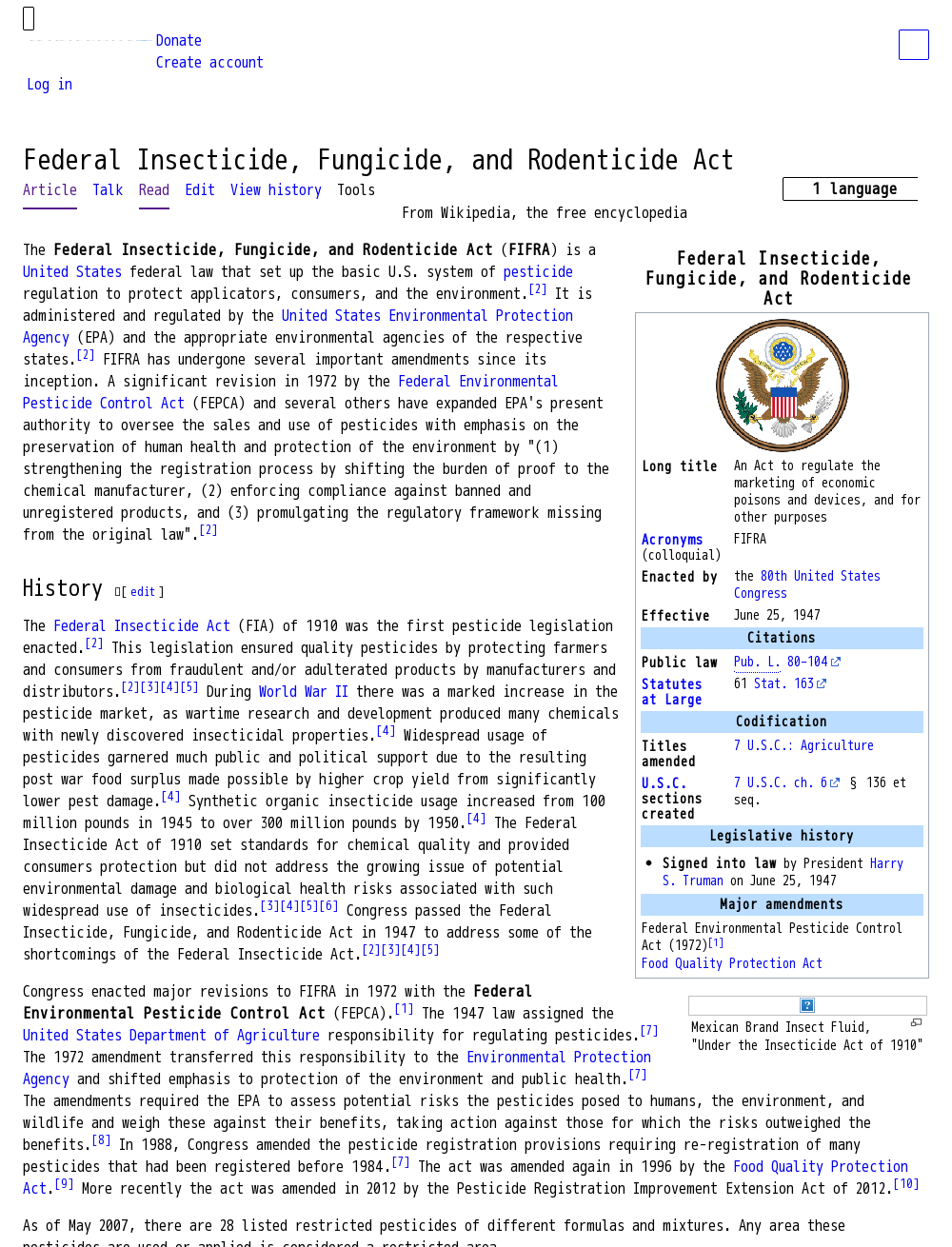
Federal Insecticide,
Fungicide, and Rodenticide
Act
Long title
An Act to regulate the
marketing of economic
poisons and devices, and for
other purposes
(colloquial)
FIFRA
Enacted by
the
Effective
June 25, 1947
Citations
Public law
61
Codification
Titles
amended
sections
created
§ 136 et
seq.
Legislative history
Signed into law
by President
on June 25, 1947
Major amendments
Federal Environmental Pesticide Control
Act (1972)
The
Federal Insecticide, Fungicide, and Rodenticide Act
(
FIFRA
) is a
federal law that set up the basic U.S. system of
regulation to protect applicators, consumers, and the environment.
It is
administered and regulated by the
(EPA) and the appropriate environmental agencies of the respective
states.
FIFRA has undergone several important amendments since its
inception.
A significant revision in 1972 by the
(FEPCA) and several others have expanded EPA's present
authority to oversee the sales and use of pesticides with emphasis on the
preservation of human health and protection of the environment by "(1)
strengthening the registration process by shifting the burden of proof to the
chemical manufacturer, (2) enforcing compliance against banned and
unregistered products, and (3) promulgating the regulatory framework missing
from the original law".
History
[
]
Mexican Brand Insect Fluid,
"Under the Insecticide Act of 1910"
The
(FIA) of 1910 was the first pesticide legislation
enacted.
This legislation ensured quality pesticides by protecting farmers
and consumers from fraudulent and/or adulterated products by manufacturers and
distributors.
During
there was a marked increase in the
pesticide market, as wartime research and development produced many chemicals
with newly discovered insecticidal properties.
Widespread usage of
pesticides garnered much public and political support due to the resulting
post war food surplus made possible by higher crop yield from significantly
lower pest damage.
Synthetic organic insecticide usage increased from 100
million pounds in 1945 to over 300 million pounds by 1950.
The Federal
Insecticide Act of 1910 set standards for chemical quality and provided
consumers protection but did not address the growing issue of potential
environmental damage and biological health risks associated with such
widespread use of insecticides.
Congress passed the Federal
Insecticide, Fungicide, and Rodenticide Act in 1947 to address some of the
shortcomings of the Federal Insecticide Act.
Congress enacted major revisions to FIFRA in 1972 with the
Federal
Environmental Pesticide Control Act
(FEPCA).
The 1947 law assigned the
responsibility for regulating pesticides.
The 1972 amendment transferred this responsibility to the
and shifted emphasis to protection of the environment and public health.
The amendments required the EPA to assess potential risks the pesticides posed to humans, the environment, and
wildlife and weigh these against their benefits, taking action against those for which the risks outweighed the
benefits.
In 1988, Congress amended the pesticide registration provisions requiring re-registration of many
pesticides that had been registered before 1984.
The act was amended again in 1996 by the
.
More recently the act was amended in 2012 by the Pesticide Registration Improvement Extension Act of 2012.
As of May 2007, there are 28 listed restricted pesticides of different formulas and mixtures. Any area these
pesticides are used or applied is considered a restricted area.
Major code sections
[
]
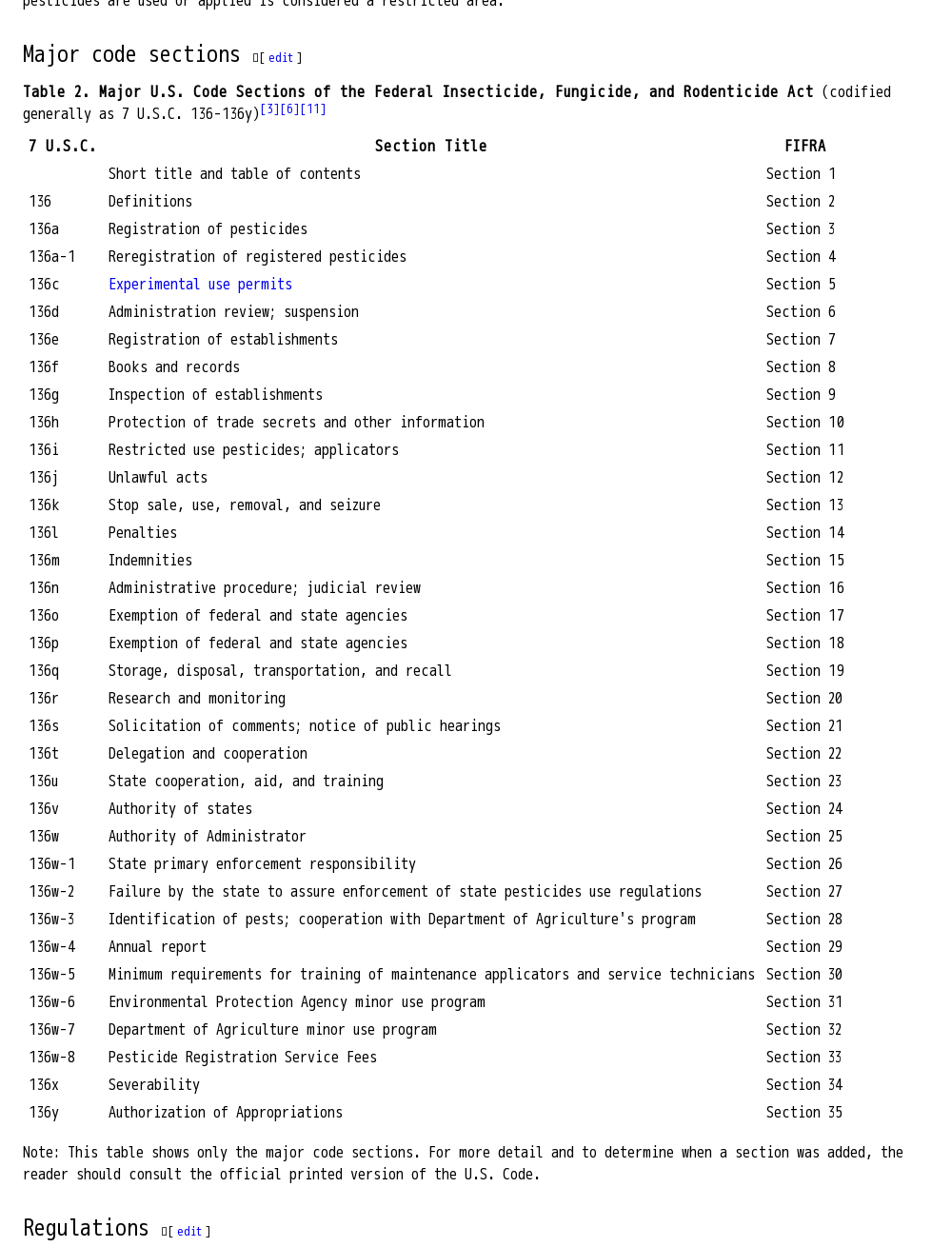
Table 2. Major U.S. Code Sections of the Federal Insecticide, Fungicide, and Rodenticide Act
(codified
generally as 7 U.S.C. 136-136y)
7 U.S.C.
Section Title
FIFRA
Short title and table of contents
Section 1
136
Definitions
Section 2
136a
Registration of pesticides
Section 3
136a-1
Reregistration of registered pesticides
Section 4
136c
Section 5
136d
Administration review; suspension
Section 6
136e
Registration of establishments
Section 7
136f
Books and records
Section 8
136g
Inspection of establishments
Section 9
136h
Protection of trade secrets and other information
Section 10
136i
Restricted use pesticides; applicators
Section 11
136j
Unlawful acts
Section 12
136k
Stop sale, use, removal, and seizure
Section 13
136l
Penalties
Section 14
136m
Indemnities
Section 15
136n
Administrative procedure; judicial review
Section 16
136o
Exemption of federal and state agencies
Section 17
136p
Exemption of federal and state agencies
Section 18
136q
Storage, disposal, transportation, and recall
Section 19
136r
Research and monitoring
Section 20
136s
Solicitation of comments; notice of public hearings
Section 21
136t
Delegation and cooperation
Section 22
136u
State cooperation, aid, and training
Section 23
136v
Authority of states
Section 24
136w
Authority of Administrator
Section 25
136w-1
State primary enforcement responsibility
Section 26
136w-2
Failure by the state to assure enforcement of state pesticides use regulations
Section 27
136w-3
Identification of pests; cooperation with Department of Agriculture's program
Section 28
136w-4
Annual report
Section 29
136w-5
Minimum requirements for training of maintenance applicators and service technicians
Section 30
136w-6
Environmental Protection Agency minor use program
Section 31
136w-7
Department of Agriculture minor use program
Section 32
136w-8
Pesticide Registration Service Fees
Section 33
136x
Severability
Section 34
136y
Authorization of Appropriations
Section 35
Note: This table shows only the major code sections. For more detail and to determine when a section was
added, the
reader should consult the official printed version of the U.S. Code.
Regulations
[
]
In order to be considered for use, pesticides had to undergo 120 tests with regards to safety and its actual
effectiveness. Because of these rigorous test, only 1 in 139,000 actually make it through to be used in agriculture.
[
]
This act directly
forbids
certain substances and certain uses of those substances, as distinguished
from other legislation regulating pesticides, which impose costs on certain practices but do not
outlaw
any.
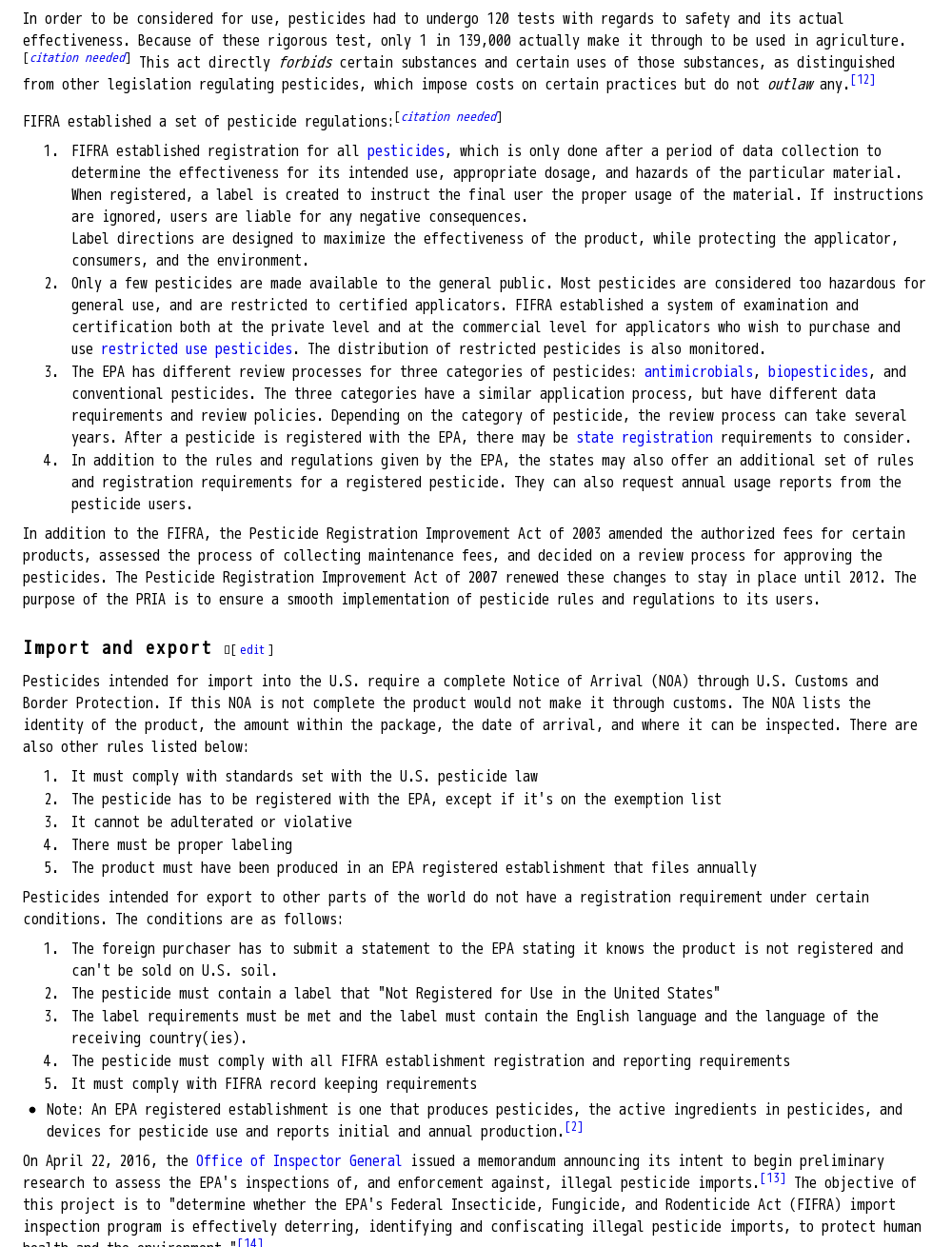
FIFRA established a set of pesticide regulations:
[
]
FIFRA established registration for all
, which is only done after a period of data collection to
determine the effectiveness for its intended use, appropriate dosage, and hazards of the particular material.
When registered, a label is created to instruct the final user the proper usage of the material. If instructions
are ignored, users are liable for any negative
consequences.
Label directions are designed to maximize the effectiveness of the product, while protecting the applicator,
consumers, and the environment.
Only a few pesticides are made available to the general public. Most pesticides are considered too hazardous for
general use, and are restricted to certified applicators. FIFRA established a system of examination and
certification both at the private level and at the commercial level for applicators who wish to purchase and
use
. The distribution of restricted pesticides is also monitored.
The EPA has different review processes for three categories of pesticides:
,
, and
conventional pesticides.
The three categories have a similar application process, but have different data
requirements and review policies.
Depending on the category of pesticide, the review process can take several
years.
After a pesticide is registered with the EPA, there may be
requirements to consider.
In addition to the rules and regulations given by the EPA, the states may also offer an additional set of rules
and registration requirements for a registered pesticide. They can also request annual usage reports from the
pesticide users.
In addition to the FIFRA, the Pesticide Registration Improvement Act of 2003 amended the authorized fees for certain
products, assessed the process of collecting maintenance fees, and decided on a review process for approving the
pesticides. The Pesticide Registration Improvement Act of 2007 renewed these changes to stay in place until 2012. The
purpose of the PRIA is to ensure a smooth implementation of pesticide rules and regulations to its users.
Import and export
[
]
Pesticides intended for import into the U.S. require a complete Notice of Arrival (NOA) through U.S. Customs and
Border Protection. If this NOA is not complete the product would not make it through customs. The NOA lists the
identity of the product, the amount within the package, the date of arrival, and where it can be inspected. There are
also other rules listed below:
It must comply with standards set with the U.S. pesticide law
The pesticide has to be registered with the EPA, except if it's on the exemption list
It cannot be adulterated or violative
There must be proper labeling
The product must have been produced in an EPA registered establishment that files annually
Pesticides intended for export to other parts of the world do not have a registration requirement under certain
conditions. The conditions are as follows:
The foreign purchaser has to submit a statement to the EPA stating it knows the product is not registered and
can't be sold on U.S. soil.
The pesticide must contain a label that "Not Registered for Use in the United States"
The label requirements must be met and the label must contain the English language and the language of the
receiving country(ies).
The pesticide must comply with all FIFRA establishment registration and reporting requirements
It must comply with FIFRA record keeping requirements
Note: An EPA registered establishment is one that produces pesticides, the active ingredients in pesticides, and
devices for pesticide use and reports initial and annual production.
On April 22, 2016, the
issued a memorandum announcing its intent to begin preliminary
research to assess the EPA's inspections of, and enforcement against, illegal pesticide imports.
The objective of
this project is to "determine whether the EPA's Federal Insecticide, Fungicide, and Rodenticide Act (FIFRA) import
inspection program is effectively deterring, identifying and confiscating illegal pesticide imports, to protect human
health and the environment."
Registration of pesticide products
[
]
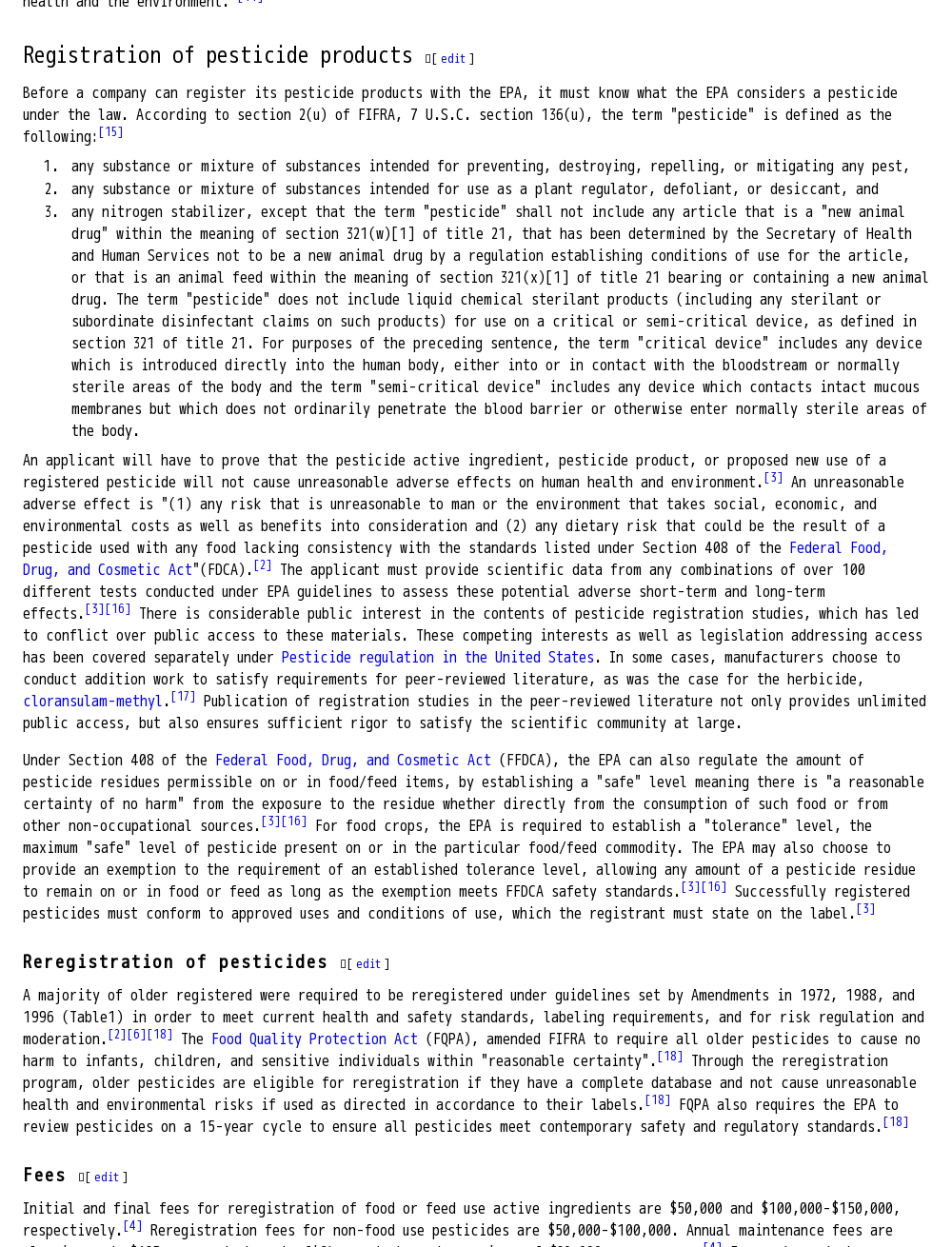
Before a company can register its pesticide products with the EPA, it must know what the EPA considers a pesticide
under the law.
According to section 2(u) of FIFRA, 7 U.S.C. section 136(u), the term "pesticide" is defined as the
following:
any substance or mixture of substances intended for preventing, destroying, repelling, or mitigating any pest,
any substance or mixture of substances intended for use as a plant regulator, defoliant, or desiccant, and
any nitrogen stabilizer, except that the term "pesticide" shall not include any article that is a "new animal
drug" within the meaning of section 321(w)[1] of title 21, that has been determined by the Secretary of Health
and Human Services not to be a new animal drug by a regulation establishing conditions of use for the article,
or that is an animal feed within the meaning of section 321(x)[1] of title 21 bearing or containing a new animal
drug. The term "pesticide" does not include liquid chemical sterilant products (including any sterilant or
subordinate disinfectant claims on such products) for use on a critical or semi-critical device, as defined in
section 321 of title 21. For purposes of the preceding sentence, the term "critical device" includes any device
which is introduced directly into the human body, either into or in contact with the bloodstream or normally
sterile areas of the body and the term "semi-critical device" includes any device which contacts intact mucous
membranes but which does not ordinarily penetrate the blood barrier or otherwise enter normally sterile areas of
the body.
An applicant will have to prove that the pesticide active ingredient, pesticide product, or proposed new use of a
registered pesticide will not cause unreasonable adverse effects on human health and environment.
An unreasonable
adverse effect is "(1) any risk that is unreasonable to man or the environment that takes social, economic, and
environmental costs as well as benefits into consideration and (2) any dietary risk that could be the result of a
pesticide used with any food lacking consistency with the standards listed under Section 408 of the
"(FDCA).
The applicant must provide scientific data from any combinations of over 100
different tests conducted under EPA guidelines to assess these potential adverse short-term and long-term
effects.
There is considerable public interest in the contents of pesticide registration studies, which has led
to conflict over public access to these materials.
These competing interests as well as legislation addressing access
has been covered separately under
.
In some cases, manufacturers choose to
conduct addition work to satisfy requirements for peer-reviewed literature, as was the case for the herbicide,
.
Publication of registration studies in the peer-reviewed literature not only provides unlimited
public access, but also ensures sufficient rigor to satisfy the scientific community at large.
Under Section 408 of the
(FFDCA), the EPA can also regulate the amount of
pesticide residues permissible on or in food/feed items, by establishing a "safe" level meaning there is "a reasonable
certainty of no harm" from the exposure to the residue whether directly from the consumption of such food or from
other non-occupational sources.
For food crops, the EPA is required to establish a "tolerance" level, the
maximum "safe" level of pesticide present on or in the particular food/feed commodity.
The EPA may also choose to
provide an exemption to the requirement of an established tolerance level, allowing any amount of a pesticide residue
to remain on or in food or feed as long as the exemption meets FFDCA safety standards.
Successfully registered
pesticides must conform to approved uses and conditions of use, which the registrant must state on the label.
Reregistration of pesticides
[
]
A majority of older registered were required to be reregistered under guidelines set by Amendments in 1972, 1988, and
1996 (Table1) in order to meet current health and safety standards, labeling requirements, and for risk regulation and
moderation.
The
(FQPA), amended FIFRA to require all older pesticides to cause no
harm to infants, children, and sensitive individuals within
"reasonable certainty".
Through the reregistration
program, older pesticides are eligible for reregistration if they have a complete database and not cause unreasonable
health and environmental risks if used as directed in accordance to their labels.
FQPA also requires the EPA to
review pesticides on a 15-year cycle to ensure all pesticides meet contemporary safety and regulatory standards.
Fees
[
]
Initial and final fees for reregistration of food or feed use active ingredients are $50,000 and $100,000-$150,000,
respectively.
Reregistration fees for non-food use pesticides are $50,000-$100,000. Annual maintenance fees are
also imposed: $425 per product up to fifty products and a maximum of $20,000 per company.
For each product over
fifty, the fee is $100, for a maximum fee of $35,000.
Fees may be reduced or waived for small business registrants,
public health pesticides, or minor use pesticides at the EPA's discretion, and failure to pay reregistration fees or
maintenance fees may result in cancellation of a product registration.
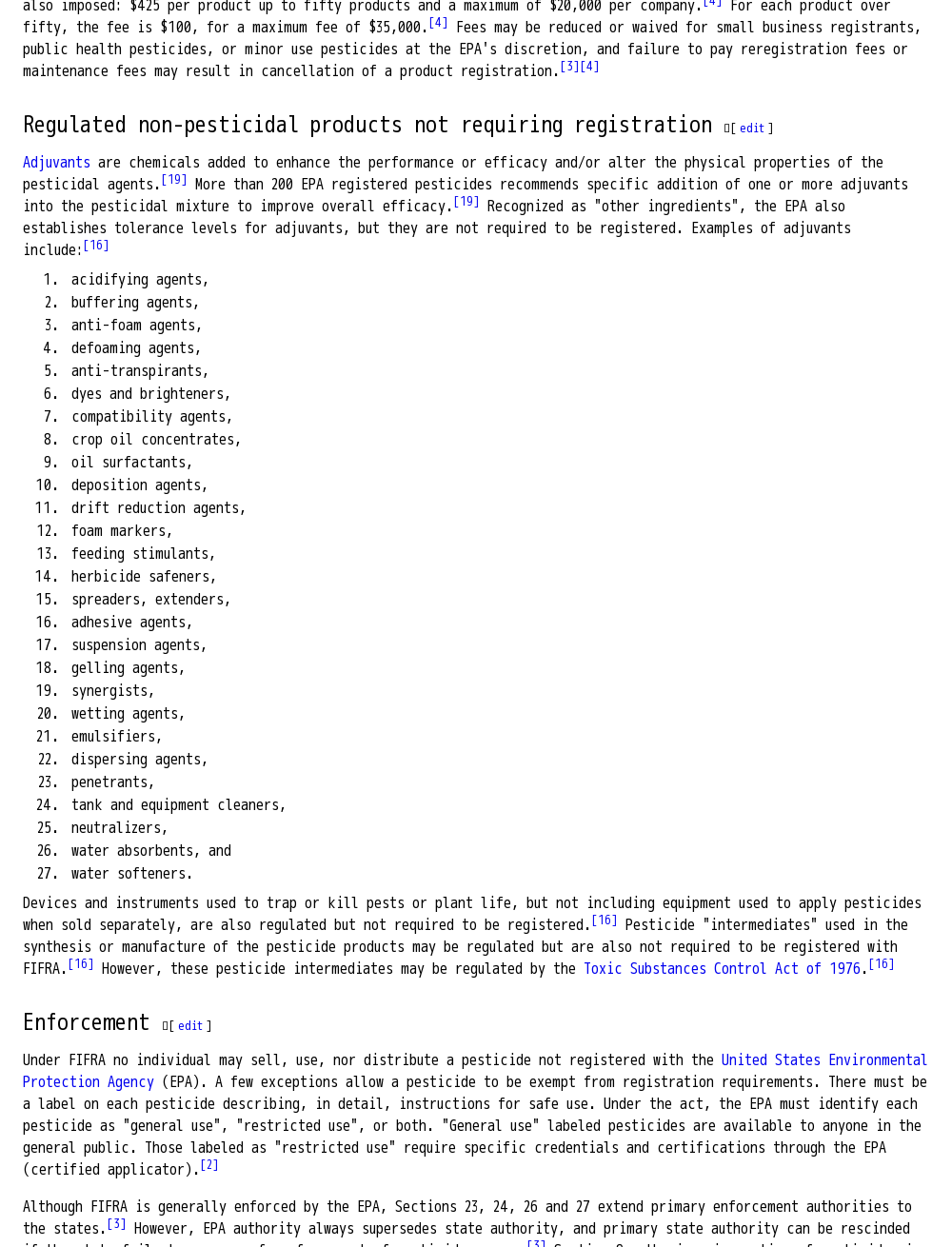
Regulated non-pesticidal products not requiring registration
[
]
are chemicals added to enhance the performance or efficacy and/or alter the physical properties of the
pesticidal agents.
More than 200 EPA registered pesticides recommends specific addition of one or more adjuvants
into the pesticidal mixture to improve overall efficacy.
Recognized as "other ingredients", the EPA also
establishes tolerance levels for adjuvants, but they are not required to be registered. Examples of adjuvants
include:
acidifying agents,
buffering agents,
anti-foam agents,
defoaming agents,
anti-transpirants,
dyes and brighteners,
compatibility agents,
crop oil concentrates,
oil surfactants,
deposition agents,
drift reduction agents,
foam markers,
feeding stimulants,
herbicide safeners,
spreaders, extenders,
adhesive agents,
suspension agents,
gelling agents,
synergists,
wetting agents,
emulsifiers,
dispersing agents,
penetrants,
tank and equipment cleaners,
neutralizers,
water absorbents, and
water softeners.
Devices and instruments used to trap or kill pests or plant life, but not including equipment used to apply pesticides
when sold separately, are also regulated but not required to be registered.
Pesticide "intermediates" used in the
synthesis or manufacture of the pesticide products may be regulated but are also not required to be registered with
FIFRA.
However, these pesticide intermediates may be regulated by the
.
Enforcement
[
]
Under FIFRA no individual may sell, use, nor distribute a pesticide not registered with the
(EPA). A few exceptions allow a pesticide to be exempt from registration requirements. There must be
a label on each pesticide describing, in detail, instructions for safe use. Under the act, the EPA must identify each
pesticide as "general use", "restricted use", or both. "General use" labeled pesticides are available to anyone in the
general public. Those labeled as "restricted use" require specific credentials and certifications through the EPA
(certified applicator).
Although FIFRA is generally enforced by the EPA, Sections 23, 24, 26 and 27 extend primary enforcement authorities to
the states.
However, EPA authority always supersedes state authority, and primary state authority can be rescinded
if the state fails to assure safe enforcement of pesticides usage.
Section 9 authorizes inspection of pesticides in
storage for sale or distribution.
Under Section 13, EPA may issue a Stop Sale, Use or Removal Order (SSURO) to
prevent the sale or distribution of violative pesticides and for the authority to seize these pesticides.
Section
15 provides indemnity payments for suspended or cancelled registrations.
Section 16 allows for a judicial review
process for individuals or entities affected by an EPA order or action.
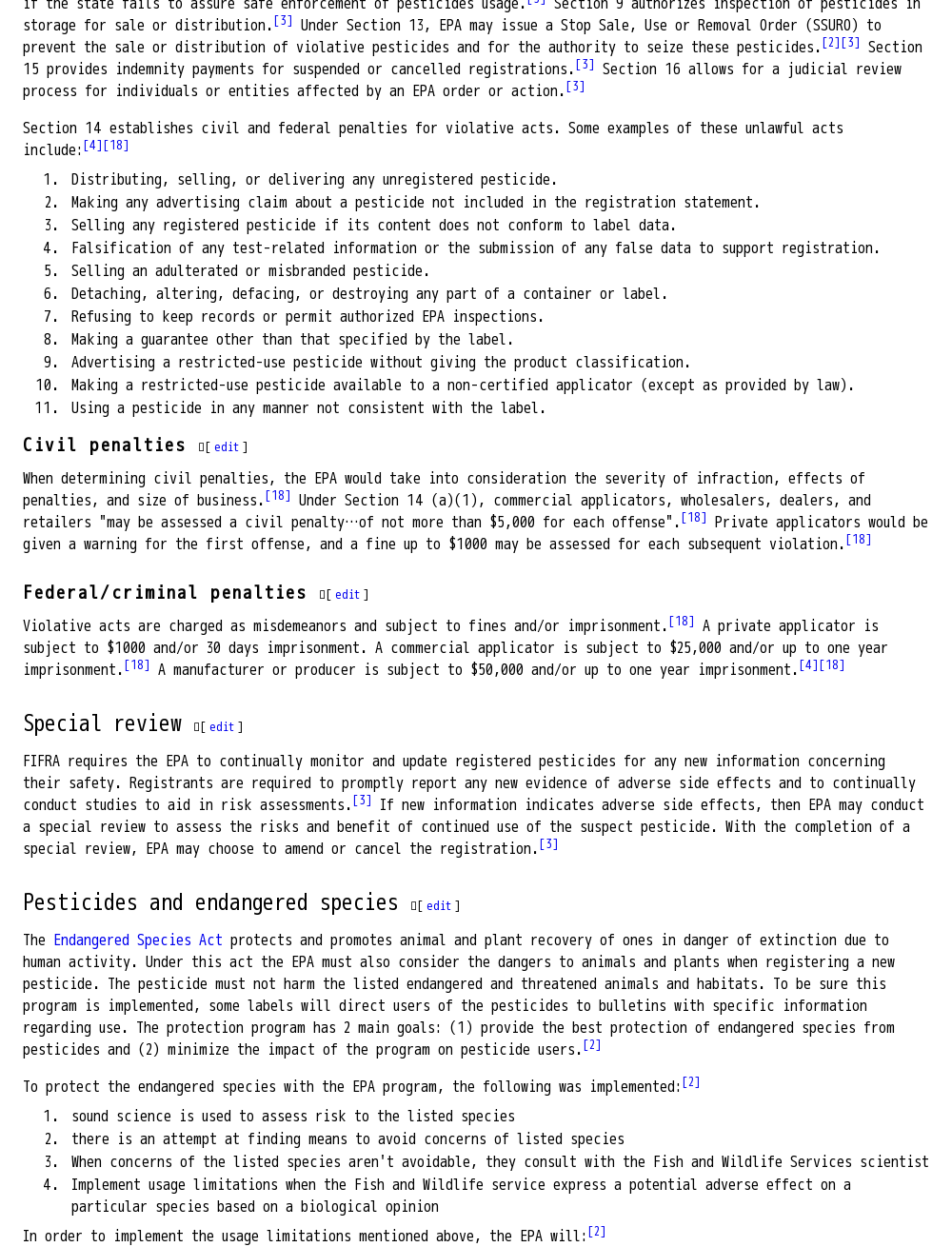
Section 14 establishes civil and federal penalties for violative acts.
Some examples of these unlawful acts
include:
Distributing, selling, or delivering any unregistered pesticide.
Making any advertising claim about a pesticide not included in the registration statement.
Selling any registered pesticide if its content does not conform to label data.
Falsification of any test-related information or the submission of any false data to support registration.
Selling an adulterated or misbranded pesticide.
Detaching, altering, defacing, or destroying any part of a container or label.
Refusing to keep records or permit authorized EPA inspections.
Making a guarantee other than that specified by the label.
Advertising a restricted-use pesticide without giving the product classification.
Making a restricted-use pesticide available to a non-certified applicator (except as provided by law).
Using a pesticide in any manner not consistent with the label.
Civil penalties
[
]
When determining civil penalties, the EPA would take into consideration the severity of infraction, effects of
penalties, and size of business.
Under Section 14 (a)(1), commercial applicators, wholesalers, dealers, and
retailers "may be assessed a civil penalty…of not more than $5,000 for each offense".
Private applicators would be
given a warning for the first offense, and a fine up to $1000 may be assessed for each subsequent violation.
Federal/criminal penalties
[
]
Violative acts are charged as misdemeanors and subject to fines and/or imprisonment.
A private applicator is
subject to $1000 and/or 30 days imprisonment.
A commercial applicator is subject to $25,000 and/or up to one year
imprisonment.
A manufacturer or producer is subject to $50,000 and/or up to one year imprisonment.
Special review
[
]
FIFRA requires the EPA to continually monitor and update registered pesticides for any new information concerning
their safety. Registrants are required to promptly report any new evidence of adverse side effects and to continually
conduct studies to aid in risk assessments.
If new information indicates adverse side effects, then EPA may conduct
a special review to assess the risks and benefit of continued use of the suspect pesticide.
With the completion of a
special review, EPA may choose to amend or cancel the registration.
Pesticides and endangered species
[
]
The
protects and promotes animal and plant recovery of ones in danger of extinction due to
human activity. Under this act the EPA must also consider the dangers to animals and plants when registering a new
pesticide. The pesticide must not harm the listed endangered and threatened animals and habitats. To be sure this
program is implemented, some labels will direct users of the pesticides to bulletins with specific information
regarding use. The protection program has 2 main goals: (1) provide the best protection of endangered species from
pesticides and (2) minimize the impact of the program on pesticide users.
To protect the endangered species with the EPA program, the following was implemented:
sound science is used to assess risk to the listed species
there is an attempt at finding means to avoid concerns of listed species
When concerns of the listed species aren't avoidable, they consult with the Fish and Wildlife Services scientist
Implement usage limitations when the Fish and Wildlife service express a potential adverse effect on a
particular species based on a biological opinion
In order to implement the usage limitations mentioned above, the EPA will:
add a generic label to the pesticide
develop bulletins containing habitat location and pesticide use limitations
distributing the bulletins containing this information to pesticide users
providing a toll-free number for users to contact regarding information in bulletins and how to obtain one.
See also
[
]
References
[
]
^
Federal Environmental Pesticide Control Act,
. Approved 1972-10-21.
^
US EPA, OP (22 February 2013).
.
www.epa.gov
. Retrieved
3 October
2022
.
^
Schierow, Linda-Jo (1 February 2012).
(PDF)
.
p. 6. Archived from
(PDF)
on 27 September 2013
. Retrieved
8 March
2012
.
^
Finegan, Pamela (1 April 1989).
.
Pace Environmental Law Review
.
6
(2): 623
. Retrieved
12 March
2012
.
^
Toth, Stephen.
(PDF)
. Retrieved
12 March
2012
.
^
Schierow, Linda-Jo.
. Archived from
on 15 January
2015
. Retrieved
12 March
2012
.
^
Willson, Harold R (February 23, 1996),
2011-06-17 at the
.
IPM World
Textbook.
University of Minnesota. Retrieved on 2007-10-15.
Susan Wayland and Penelope Fenner-Crisp.
EPA Alumni Association.
March 2016.
Food Quality Protection Act,
. Approved 1996-08-03.
Pesticide Registration Improvement Extension Act of 2012,
. Approved 2012-09-28.
(PDF)
. Cornell University Law School -
Legal Information Institute
. Retrieved
20 April
2012
.
Eyring, Gregory (1992).
Green Products by Design: Choices for a Cleaner Environment
. Diane Publishing Company.
.
Campbell, Lisa M.; Burchi, Lisa R. (6 May 2016).
.
The National Law Review
. Bergeson & Campbell, P.C
. Retrieved
22 May
2016
.
(PDF)
. The Office of Inspector General (OIG)
for the U.S. Environmental Protection Agency ( EPA ). 22 April 2016
. Retrieved
22 May
2016
.
.
7 USC Chapter 6 - INSECTICIDES AND ENVIRONMENTAL PESTICIDE CONTROL
. Cornell University Law
School - Legal Information Institute
. Retrieved
31 March
2012
.
^
. Retrieved
1 April
2012
.
Wolt, J. D., J.K. Smith, J.K. Sims, and D.O. Duebelbeis. 1996. Products and kinetics of cloramsulam-methyl aerobic soil
metabolism. J. Agric. Food Chem.
44:324-332.
^
Utah Department of Agriculture and Food.
(PDF)
. Archived from
(PDF)
on 2012-01-05.
^
Hock, Winand K.
(PDF)
. Publications Distribution Center, The Pennsylvania State
University
. Retrieved
1 April
2012
.
Further reading
[
]
, a report by the EPA Alumni Association
External links
[
]
subchapter II of the
from the
subchapter II of the
from the
(
/
) as amended in the
from
History
Agencies
Regulations
Programs
Related topics
decisions
(1920)
(1972)
(1978)
(1979)
(1990)
(2000)
(2021)
cases
(1973)
(1983)
(1983)
(2004)
(2004)
(2008)
(2010)
cases
(1975)
(1984)
(2001)
(2004)
(2004)
(2007)
(2007)
(2011)
(2014)
(2015)
(2021)
(2022)
cases
(1978)
(2012)
cases
(1978)
(1992)
(1995)
(2007)
(2018)
(2021)
cases
(1985)
(2001)
(2004)
(2006)
(2006)
(2007)
(2009)
(2009)
(2012)
(2013)
(2016)
(2018)
(2020)
(2023)
cases
(1998)
(2021)
Major
,
treaties,
and lower court
decisions
(1872)
(1897)
(1899)
(1900)
(1911)
(1911)
(1913)
(1918)
(1924)
(1924)
(1928)
(1934)
(1954)
(1955)
(1956)
(1961)
(1963, 1970, 1977, 1990)
(2nd Cir. Court of Appeals, 1965)
(1965)
(1969)
(1970)
(1970)
(1972, 1977, 1987, 2014)
(1972)
(1972)
(1972)
(1972)
(1973)
(1973)
(1974, 1986,
1996)
(
,
,
,
,
,
,
,
,
,
,
2014, 2016, 2022)
(1975)
(1975)
(1976)
(1976)
(1976)
(1977)
(1978)
(1980)
(1986)
(1986)
(1990)
(1990)
(1990)
(1996)
(2005)
(2007)
(D.C. Cir. Court of Appeals, 2012)
(2016)
(2018)
(2021)
(5th Cir. Court of Appeals, 2022)
(2022)
(2022)
and concepts
(2007)
(2022)
(2010)
(2010)
Environmental
law school programs
at Pace University
at the
University of Utah
(1969–1974)
(1953–1961)
(1950–1953)
for
(1947–1950)
"
"
"
"
"
"
Life and
politics
"
"
Books
U.S. House of Representatives:
U.S. Senate:
California gubernatorial election:
GOP
presidential primaries:
GOP national conventions:
Presidential elections:
"
"
(1972 play)
(1972
film)
(1972 film)
(1973 film)
(1977 novel)
(1977 miniseries)
(1989 film)
(1999 TV series)
(2000 film)
(2002
film)
(2004 film)
(
,
)
(2009 film)
"
" (2011 TV episode)
(2014 film)
(2015 novel)
(2017
film)
(2019 board game)
Related
Staff
(aide de camp)
(early campaign manager)
(valet)
(secretary)
Family
(wife)
(daughter)
(daughter)
(grandson)
(granddaughter)
(father)
(mother)
(brother)
(brother)
International
National
:
This page was last edited on 26 May 2026, at 14:49
(UTC)
.
Text is available under the
;
additional terms may apply. By using this site, you agree to the
and
. Wikipedia® is a registered trademark of the
, a non-profit organization.