Emoticon
63 languages
Tools
Checked
From Wikipedia, the free
encyclopedia
(Redirected from
)
Many emoticons redirect here. For the list, see
.
Not to be confused with
,
,
, or
.
"O.O" redirects here. For other uses, see
and
.
This article contains
.
Without proper
, you may see
instead of the
intended characters.
An emoticon portraying a
smiling face
Examples of
smileys
An
emoticon
(
,
, rarely
,
;
of emotion and icon
) is a pictorial representation of a
using
—usually
,
and
—to
express a person's feelings, mood or reaction, without needing to describe it in
detail.
emoticons can be traced back hundreds of years with various one-off uses. The
protocol as a way to use them to communicate emotion in conversations is credited to
computer scientist
, who proposed what came to be known as "
"—
:-
)
and
:-(
—in a message on the
(BBS) of
in 1982. In Western countries, emoticons are usually written at a right angle to the
direction of the text.
Users from
popularized a kind of emoticon called
,
using
. This style arose on ASCII NET of Japan in
1986.
They are also known as
verticons
(from
vertical emoticon
) due to their
readability without rotations.
This is often seen as the 1st generation of emoticons.
The second generation began when computing became more common in the west, and people
began replacing the previous
with actual emoticon icons or designs. One term used to define these types of
emoticons compared to ASCII was portrait emoticons, as portrait emoticons are meant to resemble a face from the front
like a
. The use of these emoticons became prevalent when
mobile text messaging and the
became widespread in the late 1990s, emoticons became increasingly popular and were commonly used in
,
and
. Over time, the designs became more elaborate and emoticons such as 🙂 by
became commonly
referred to as Emoticons. They have played a significant role in communication as technology for communication
purposes advanced and increased in use. Emoticons today convey non-verbal cues of language, such as facial expressions
but also hand gestures, with
stating in interviews that emoticons now allow for greater emotional
understanding in writing when emoticons are used.
Emoticons were the precursors to modern
not just for
facial expressions, but also replacing categories like weather, sports and animals.
History
[
]
ASCII art and faces (pre-1981)
[
]
Cover of the French magazine
, text of a legal ruling
against the magazine in the shape
of a
, 1834
The use of typographic symbols to represent facial expression can be observed as
early as
, where
employs the word "omo" as a preemoticon
representation of the human face. The two letters "o" signify sunken eyes, while the
letter "m" forms the angular outlines of the eyelids, nose, and cheeks, depicting
an emaciated face marked by hunger and thirst.
Their sockets were like rings without the gems;
Whoever in the face of men reads 'omo'
Might well in these have recognised the 'm.'
—
Purgatorio
XXIII. 31-33
In 1648, poet
wrote, "Tumble me down, and I will sit Upon my ruins, (smiling yet:)." Herrick's work
predated any other recorded use of
as a smiling face by around 200 years. However, experts doubted the
inclusion of the
in the poem was deliberate and if it was meant to represent a smiling face. English professor
Alan Jacobs argued that "punctuation, in general, was unsettled in the seventeenth century ... Herrick was unlikely to
have consistent punctuational practices himself, and even if he did he couldn't expect either his printers or his
readers to share them."
17th century typography practice often placed colons and semicolons within parentheses,
including 14 instances of "
:)
" in
's 1653
Plain Scripture Proof of Infants Church-membership and
Baptism
.
Precursors to modern emoticons have existed since the 19th century.
The
National Telegraphic Review and
Operators Guide
in April 1857 documented the use of the number 73 in
to express "love and kisses"
(later
reduced to the more formal "
").
Dodge's Manual
in 1908 documented the reintroduction of "love and kisses"
as the number 88. New Zealand academics Joan Gajadhar and John Green comment that both
are
more succinct than modern abbreviations such as
.
Transcript of
's
speech in 1862
The transcript of one of
's speeches in 1862 recorded the audience's
reaction as: "(applause and laughter ;)".
There has been some debate whether
the glyph in Lincoln's speech was a
, a legitimate punctuation construct or the
first emoticon.
Linguist Philip Seargeant argues that it was a simple
error.
"Typographical art" published in
the March 5, 1881, issue of
Kurjer
Warszawski
Emoticons in the satirical
magazine
on March 30, 1881
Before March 1881, the examples of "typographical art" appeared in at least three
newspaper articles, including
(published in
) from March 5,
1881, using punctuation to represent the emotions of joy, melancholy, indifference
and astonishment.
Telegraphische Zeichenkunst
in
the German
Deutsche Postzeitung
,
November 16, 1896
In a 1912 essay titled "For Brevity and Clarity", American author
suggested facetiously
that a bracket could be used to represent a smiling
face, proposing "an improvement in punctuation" with which writers could convey
, loud or immoderate laughter: "it is written thus ‿ and presents a
smiling mouth. It is to be appended, with the full stop, to every jocular or
ironical sentence".
In a 1936
article, writer Alan Gregg
proposed combining brackets with various other
to represent
various moods. Brackets were used for the sides of the mouth or cheeks, with other
punctuation used between the brackets to display various emotions:
(-)
for a smile,
(--)
(showing more "teeth") for laughter,
(#)
for a frown and
(*)
for a
.
An instance of text characters representing a sideways smiling and frowning face could be found in the
on March 10, 1953, promoting the film
Lili
starring
.
The September 1962 issue of
included an article titled "Typewri-toons". The piece, featuring typewriter-
generated artwork credited to "Royal Portable", was entirely made up of repurposed typography, including a capital
letter P having a bigger 'bust' than a capital I, a lowercase b and d discussing their pregnancies, an
on top
of a letter to indicate the letter had just come inside from snowfall, and a classroom of lowercase n's interrupted by
a lowercase h "raising its hand".
A further example attributed to a
columnist appeared in a
1967 article in
, using a
and
to represent a
:
—
).
Prefiguring the modern "smiley" emoticon,
writer
told an interviewer from
in 1969, "I often think there should exist a special typographical sign for a smile—some sort of concave mark, a
supine round bracket, which I would now like to trace in reply to your question."
In the 1970s, the
computer system was launched. It was one of the first computers used throughout educational
and professional institutions, but rarely used in a residential setting.
On the computer system, a student at the
developed pictograms that resembled different smiling faces.
and
stated this likely took place in 1972, and they claimed these to be the first emoticons.
ASCII emoticons - First generation (1982–mid-1990s)
[
]
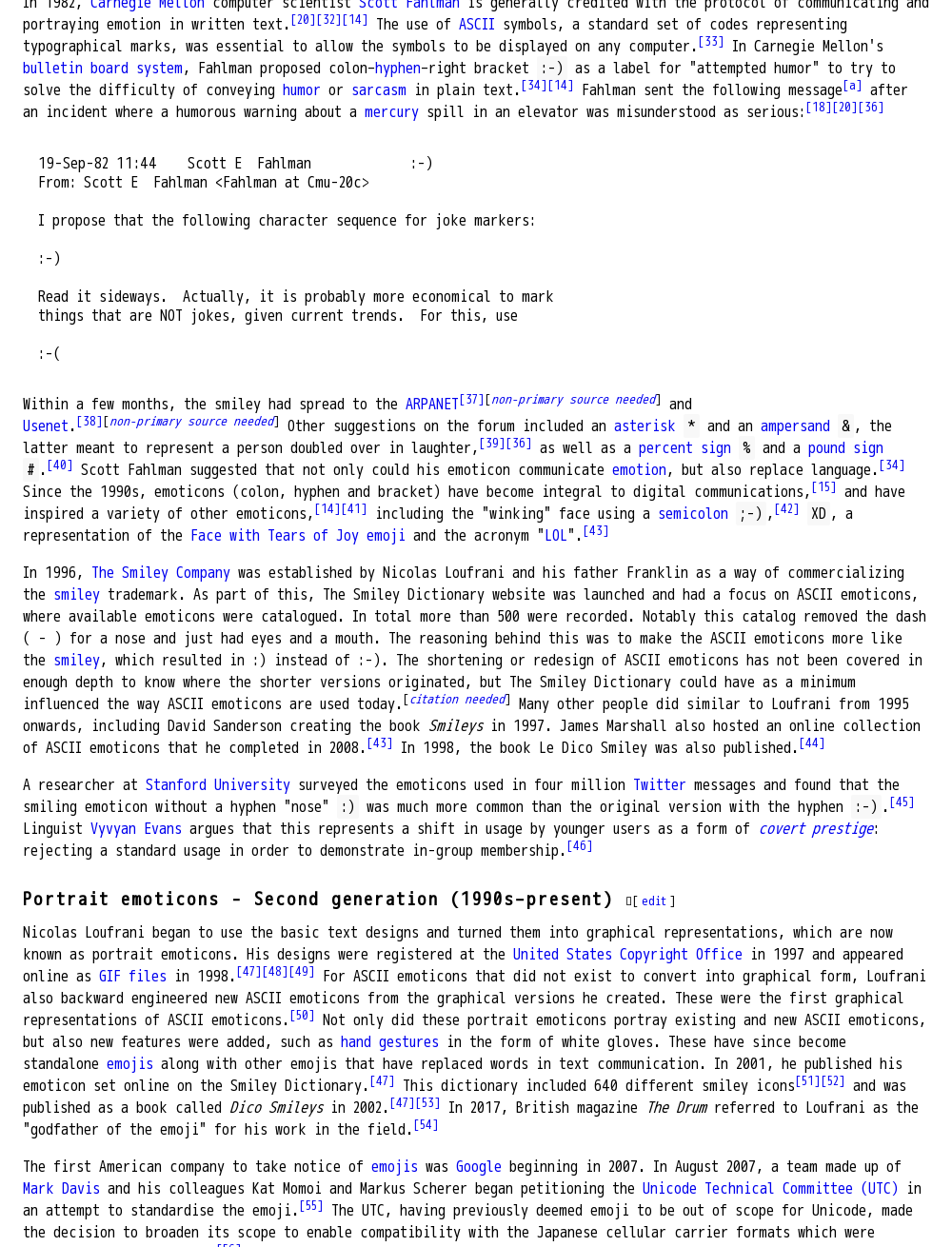
In 1982,
computer scientist
is generally credited with the protocol of communicating and
portraying emotion in written text.
The use of
symbols, a standard set of codes representing
typographical marks, was essential to allow the symbols to be displayed on any computer.
In Carnegie Mellon's
, Fahlman proposed colon–
–right bracket
:-)
as a label for "attempted humor" to try to
solve the difficulty of conveying
or
in plain text.
Fahlman sent the following message
after
an incident where a humorous warning about a
spill in an elevator was misunderstood as serious:
19-Sep-82 11:44 Scott E Fahlman :-)
From: Scott E Fahlman <Fahlman at Cmu-20c>
I propose that the following character sequence for joke markers:
:-)
Read it sideways. Actually, it is probably more economical to mark
things that are NOT jokes, given current trends. For this, use
:-(
Within a few months, the smiley had spread to the
[
]
and
.
[
]
Other suggestions on the forum included an
*
and an
&
, the
latter meant to represent a person doubled over in laughter,
as well as a
%
and a
#
.
Scott Fahlman suggested that not only could his emoticon communicate
, but also replace language.
Since the 1990s, emoticons (colon, hyphen and bracket) have become integral to digital communications,
and have
inspired a variety of other emoticons,
including the "winking" face using a
;-)
,
XD
, a
representation of the
and the acronym "
".
In 1996,
was established by Nicolas Loufrani and his father Franklin as a way of commercializing
the
trademark. As part of this, The Smiley Dictionary website was launched and had a focus on ASCII emoticons,
where available emoticons were catalogued. In total more than 500 were recorded. Notably this catalog removed the dash
( - ) for a nose and just had eyes and a mouth. The reasoning behind this was to make the ASCII emoticons more like
the
, which resulted in :) instead of :-). The shortening or redesign of ASCII emoticons has not been covered in
enough depth to know where the shorter versions originated, but The Smiley Dictionary could have as a minimum
influenced the way ASCII emoticons are used today.
[
]
Many other people did similar to Loufrani from 1995
onwards, including David Sanderson creating the book
Smileys
in 1997. James Marshall also hosted an online collection
of ASCII emoticons that he completed in 2008.
In 1998, the book Le Dico Smiley was also published.
A researcher at
surveyed the emoticons used in four million
messages and found that the
smiling emoticon without a hyphen "nose"
:)
was much more common than the original version with the hyphen
:-)
.
Linguist
argues that this represents a shift in usage by younger users as a form of
:
rejecting a standard usage in order to demonstrate in-group membership.
Portrait emoticons - Second generation (1990s–present)
[
]
Nicolas Loufrani began to use the basic text designs and turned them into graphical representations, which are now
known as portrait emoticons. His designs were registered at the
in 1997 and appeared
online as
in 1998.
For ASCII emoticons that did not exist to convert into graphical form, Loufrani
also backward engineered new ASCII emoticons from the graphical versions he created. These were the first graphical
representations of ASCII emoticons.
Not only did these portrait emoticons portray existing and new ASCII emoticons,
but also new features were added, such as
in the form of white gloves. These have since become
standalone
along with other emojis that have replaced words in text communication. In 2001, he published his
emoticon set online on the Smiley Dictionary.
This dictionary included 640 different smiley icons
and was
published as a book called
Dico Smileys
in 2002.
In 2017, British magazine
The Drum
referred to Loufrani as the
"godfather of the emoji" for his work in the field.
The first American company to take notice of
was
beginning in 2007. In August 2007, a team made up of
and his colleagues Kat Momoi and Markus Scherer began petitioning the
in
an attempt to standardise the emoji.
The UTC, having previously deemed emoji to be out of scope for Unicode, made
the decision to broaden its scope to enable compatibility with the Japanese cellular carrier formats which were
becoming more widespread.
Peter Edberg and Yasuo Kida joined the collaborative effort from
shortly
after, and their official UTC proposal came in January 2009 with 625 new emoji characters.
Notably the move
included a large set of emoticons, designed in an emoji-style but representing different emotions.
In recent times, emoticons,
and
have often become intertwined and confused.
represent the
largest set of graphical communication, but they often include portrait emoticons. In fact, the majority of the most
commonly used Emoji are emoticons (because they represent an emotion). In 2024, the
reported that 2 of the top 3
emojis were portrait emoticons.
On September 23, 2021, it was announced that
was holding an auction for the original emoticons he
created in 1982. The auction was held in
, United States, and sold the two designs as
.
The online auction ended later that month, with the originals selling for
237,500.
A year later in
2022,
auctioned off an
of 42 original graphical emoticon on
. The proceeds of
the sale went to the company's non-profit arm, Smiley Movement.
In some
, certain operators are known informally by their emoticon-like appearance. This
includes the
<=>
(a comparison), the
<>
(for type hinting) and the
?:
(a shortened
).
Styles
[
]
This section
needs additional citations for
.
Please help
by
in this section. Unsourced
material may be challenged and removed.
(
October 2021
)
(
)
Western
[
]
Usually, emoticons in Western style have the eyes on the left, followed by the nose and the mouth. It is commonly
placed at the end of a sentence, replacing the full stop. The two-character version
:)
, which omits the nose, is very
popular. The most basic emoticons are relatively consistent in form, but some can be rotated (making them tiny
). There are also some variations to emoticons to get new definitions, like changing a character to express
another feeling. For example,
:(
indicates sadness and
:((
indicates a more extreme sadness. Weeping can be written
as
:'(
. A blush can be expressed as
:">
. Others include wink
;)
, a grin
:D
,
:P
for tongue out, and smug
:->
; they
can be used to
a flirting or joking tone, or may be implying a
in the sentence preceding it.
;P
, such as when
. An often used combination is also
<3
for a
and
</3
for a broken heart.
:O
is also sometimes used to depict shock.
:/
is used to depict melancholy, disappointment or disapproval.
:|
may
be used to depict a neutral face.
A broad grin is sometimes shown with crinkled eyes to express further amusement;
XD
and the addition of further "D"
letters can suggest laughter or extreme amusement, e.g.,
XDDDD
. The "3" in
X3
and
:3
represents a cat's mouth.
An
equal sign is often used for the eyes in place of the colon, seen as
=)
. It has become more acceptable to omit the
hyphen, whether a colon or an equal sign is used for the eyes.
One linguistic study has indicated that the use of a
nose in an emoticon may be related to the user's age, with younger people less likely to use a nose.
Some variants are also more common in certain countries due to
. For example, the smiley
=)
may
occur in
.
marks are sometimes used. The letters
Ö
and
Ü
can be seen as emoticons, as the
upright versions of
:O
(meaning that one is surprised) and
:D
(meaning that one is very happy), respectively. In
countries where the
is used, the right parenthesis
)
is used as a smiley. Multiple parentheses
))))
are used to express greater happiness, amusement or laughter. The colon is omitted due to being in a lesser-known
position on the
. The '
' emoticon,
¯\_(ツ)_/¯
,
uses the glyph
from the Japanese
writing system.
Kaomoji (Japan ASCII movement)
[
]
Main article:
Kaomoji are often seen as the Japanese development of emoticons that is separate to the
movement, which
started in 1982. In 1986, a designer began to use brackets and other
to form faces. Over time,
they became more often differentiated from each other, although both use ASCII characters. However, more westernised
Kaomojis have dropped the brackets, such as
owo
,
uwu
and
TwT
, popularised in internet subcultures such as the
and
.
A kaomoji painting in Japan
2channel
[
]
Users of the Japanese discussion board
, in particular, have developed a
variety emoticons using characters from various scripts, such as
, as in
(for a look of disapproval, disbelief or confusion). Similarly, the letter ರೃ was used in emoticons to
represent a monocle and ಥ to represent a tearing eye. They were picked up by
and spread to other Western sites
soon after. Some have become characters in their own right like
.
Korean
[
]
In
, emoticons use Korean
letters, and the Western style is rarely used.
The structures of Korean
and Japanese emoticons are somewhat similar, but they have some differences. Korean style contains Korean
(letters) instead of other characters.
The consonant jamos
ㅅ
,
ㅁ
or
ㅂ
can be used as the mouth or nose component and
ㅇ
,
ㅎ
or
ㅍ
for the eyes. Using
quotation marks
"
and apostrophes
'
are also commonly used combinations. Vowel jamos such as ㅜ and ㅠ can depict a
crying face. Example:
ㅜㅜ
,
(same function as T in Western style). Sometimes ㅡ (not an
"—", but a vowel jamo),
a comma (
,
) or an
(
_
) is added, and the two character sets can be mixed together, as in
ㅠ.ㅡ
,
ㅡ^ㅜ
and
ㅜㅇㅡ
.
Also, semicolons and
are commonly used in Korean emoticons; semicolons can mean sweating, examples of it
are
-;/
,
--^
and
-_-;;
.
Chinese ideographic
[
]
See also:
The character 囧 (U+56E7), which means
'
patterned window
'
, may be combined with the posture emoticon Orz, such as
囧rz
. The character existed in
but was rarely used until its use as an emoticon,
documented as
early as January 20, 2005.
Other variants of 囧 include 崮 (king 囧), 莔 (queen 囧), 商 (囧 with a hat), 囧興 (turtle) and 卣 (
). The
character 槑 (U+69D1), a variant of 梅
'
plum
'
, is used to represent a double of 呆
'
dull
'
or further magnitude of
dullness. In Chinese, normally full characters (as opposed to the stylistic use of 槑) might be
to express
emphasis.
Posture emoticons
[
]
Orz
[
]
The emoticon
Orz
resembles a
person performing a Japanese
bow.
(other forms include:
Or2
,
on_
,
OTZ
,
OTL
,
STO
,
JTO
,
_no
,
_冂○
and
rz
) is an emoticon representing a kneeling or bowing person (the Japanese
version of which is called
), with the "o" being the head, the "r" being the
arms and part of the body, and the "z" being part of the body and the legs. This
can represent respect or
kowtowing
, but commonly appears along a range
of responses, including "frustration, despair, sarcasm, or grudging respect".
It was first used in late 2002 at the forum on Techside, a Japanese personal website. At the "Techside FAQ Forum"
(
TECHSIDE教えて君BBS(教えてBBS)
), a poster asked about a cable cover, typing "
_| ̄|○
" to show a cable and its cover.
Others commented that it looked like a kneeling person, and the symbol became popular.
[
]
These comments were soon deleted as they were considered off-topic. By 2005, Orz spawned a
: blogs have been
devoted to the emoticon, and
services have been named after it. In Taiwan, Orz is associated with the
concept of
.
o7
[
]
o7, or O7, is an emoticon that depicts a person
, with the
o
being the head and the
7
being its arm.
Multimedia variations
[
]
A
of
emotion
and
, an emotisound is a brief sound transmitted and played back during the viewing of a
message, typically an IM message or email message. The sound is intended to communicate an emotional
.
Some
services, such as MuzIcons, combine emoticons and music players in an
-based widget.
In 2004, the
chat application introduced a feature called "emotiblips", which allows Trillian users to stream files to
their instant message recipients "as the voice and video equivalent of an emoticon".
In 2007,
and
promoted the "emoticlip" as a form of
for the second
season of the show
The Hills
. The emoticlips were twelve short snippets of dialogue from the show, uploaded to YouTube.
The emoticlip concept is credited to the Bradley & Montgomery advertising firm, which wrote that they hoped it would
be widely adopted as "greeting cards that just happen to be selling something".
Intellectual property rights
[
]
Patented drop down menu for
composing phone mail text message
with emoticons
In 2000,
obtained a U.S.
registration for the "frowny"
emoticon
:-(
when used on "greeting cards, posters and art prints". In 2001, they
issued a satirical press release, announcing that they would sue Internet users who
typed the frowny; the company received protests when its mock release was posted on
technology news website
.
A number of
have been filed on inventions that assist in communicating with emoticons. A few of
these have been issued as US
. US 6987991,
for example, discloses a method developed in 2001 to send
emoticons over a cell phone using a drop-down menu. The stated advantage was that it
entering emoticons.
The emoticon
:-)
was also filed in 2006 and registered in 2008 as a European
(CTM). In
,
the
ruled in 2012 that the emoticon cannot be trademarked,
thus repealing a 2006
administrative decision trademarking the emoticons
:-)
,
=)
,
=(
,
:)
and
:(
.
In 2005, a Russian court rejected a
legal claim against
by a man who claimed to hold a trademark on the
;-)
emoticon.
In 2008, Russian
entrepreneur Oleg Teterin claimed to have been granted the trademark on the
;-)
emoticon. A license would not "cost
that much—tens of thousands of dollars" for companies but would be free of charge for individuals.
Unicode
[
]
Main article:
A different, but related, use of the term "emoticon" is found in the
, referring to a subset of
that display facial expressions.
The standard explains this usage with reference to existing systems, which
provided functionality for substituting certain textual emoticons with images or emoji of the expressions in
question.
Some smiley faces were present in Unicode since
, including a white
face, a white
face and a
black smiling face ("black" refers to a glyph which is filled, "white" refers to a glyph which is unfilled).
(partial)
(PDF)
0
1
2
3
4
5
6
7
8
9
A
B
C
D
E
F
U+263x
Notes
1.
As of Unicode version 17.0
2.
Empty areas indicate code points assigned to non-emoticon characters
3.
U+263A and U+263B are inherited from Microsoft
introduced in 1981, although inspired by older systems
The
block was introduced in
Standard
(published in October 2010) and extended by
. It
covers Unicode range from U+1F600 to U+1F64F fully.
(PDF)
0
1
2
3
4
5
6
7
8
9
A
B
C
D
E
F
U+1F60x
U+1F61x
U+1F62x
U+1F63x
U+1F64x
Notes
1.
As of Unicode version 17.0
After that block had been filled,
(2015),
(2016) and
(2017) added additional emoticons in the
range from U+1F910 to U+1F9FF. Currently, U+1F90C – U+1F90F, U+1F93F, U+1F94D – U+1F94F, U+1F96C – U+1F97F, U+1F998 –
U+1F9CF (excluding U+1F9C0 which contains the
emoji) and U+1F9E7 – U+1F9FF do not contain any emoticons since
Unicode 10.0.
(PDF)
0
1
2
3
4
5
6
7
8
9
A
B
C
D
E
F
U+1F90x
🤀
🤁
🤂
🤃
🤄
🤅
🤆
🤇
🤈
🤉
🤊
🤋
🤌
🤍
🤎
🤏
U+1F91x
🤐
🤑
🤒
🤓
🤔
🤕
🤖
🤗
🤘
🤙
🤚
🤛
🤜
🤝
🤞
🤟
U+1F92x
🤠
🤡
🤢
🤣
🤤
🤥
🤦
🤧
🤨
🤩
🤪
🤫
🤬
🤭
🤮
🤯
U+1F93x
🤰
🤱
🤲
🤳
🤴
🤵
🤶
🤷
🤸
🤹
🤺
🤻
🤼
🤽
🤾
🤿
U+1F94x
🥀
🥁
🥂
🥃
🥄
🥅
🥆
🥇
🥈
🥉
🥊
🥋
🥌
🥍
🥎
🥏
U+1F95x
🥐
🥑
🥒
🥓
🥔
🥕
🥖
🥗
🥘
🥙
🥚
🥛
🥜
🥝
🥞
🥟
U+1F96x
🥠
🥡
🥢
🥣
🥤
🥥
🥦
🥧
🥨
🥩
🥪
🥫
🥬
🥭
🥮
🥯
U+1F97x
🥰
🥱
🥲
🥳
🥴
🥵
🥶
🥷
🥸
🥹
🥺
🥻
🥼
🥽
🥾
🥿
U+1F98x
🦀
🦁
🦂
🦃
🦄
🦅
🦆
🦇
🦈
🦉
🦊
🦋
🦌
🦍
🦎
🦏
U+1F99x
🦐
🦑
🦒
🦓
🦔
🦕
🦖
🦗
🦘
🦙
🦚
🦛
🦜
🦝
🦞
🦟
U+1F9Ax
🦠
🦡
🦢
🦣
🦤
🦥
🦦
🦧
🦨
🦩
🦪
🦫
🦬
🦭
🦮
🦯
U+1F9Bx
🦰
🦱
🦲
🦳
🦴
🦵
🦶
🦷
🦸
🦹
🦺
🦻
🦼
🦽
🦾
🦿
U+1F9Cx
🧀
🧁
🧂
🧃
🧄
🧅
🧆
🧇
🧈
🧉
🧊
🧋
🧌
🧍
🧎
🧏
U+1F9Dx
🧐
🧑
🧒
🧓
🧔
🧕
🧖
🧗
🧘
🧙
🧚
🧛
🧜
🧝
🧞
🧟
U+1F9Ex
🧠
🧡
🧢
🧣
🧤
🧥
🧦
🧧
🧨
🧩
🧪
🧫
🧬
🧭
🧮
🧯
U+1F9Fx
🧰
🧱
🧲
🧳
🧴
🧵
🧶
🧷
🧸
🧹
🧺
🧻
🧼
🧽
🧾
🧿
Notes
1.
As of Unicode version 17.0
For historic and compatibility reasons, some other heads and figures, which mostly represent different aspects like
genders, activities, and professions instead of emotions, are also found in
(especially U+1F466 – U+1F487) and
. Body parts, mostly hands, are also encoded in the
and
blocks.
See also
[
]
Explanatory notes
[
]
The transcript of the conversation between several computer scientists, including
,
and
,
was believed lost before it was recovered 20 years later from old backup tapes.
References
[
]
.
Cambridge Advanced Learner's Dictionary
. Retrieved
March 22,
2018
.
.
American Heritage Dictionary
. Retrieved
March 22,
2018
.
.
Collins Dictionary
. Retrieved
March 22,
2018
.
.
Oxford Dictionaries - English
. Archived from
on August 28, 2017.
Zimmerly, Arlene; Jaehne, Julie (2003).
. McGraw-Hill
Education.
.
Emoticon: An acronym for emotion icon, a small icon composed of punctuation characters that
indicate how an e-mail message should be interpreted (that is, the writer's mood).
[
]
.
Staff.aist.go.jp
. Archived from
on December 3, 2012
. Retrieved
March 14,
2013
.
Yasumoto-Nicolson, Ken (September 19, 2007).
.
Whatjapanthinks.com
. Archived from
on May 1, 2021
. Retrieved
August 10,
2017
.
N'Diaye, Karim (January 8, 2009) [2006].
. International cognition & culture
institute.
from the original on March 29, 2024
. Retrieved
March 29,
2024
.
.
. June 3, 2021.
Williams, Alex (July 29, 2007).
.
. Retrieved
March 22,
2018
.
Madrigal, Alexis C. (April 14, 2014).
.
.
Zimmer, Ben (April 15, 2014).
.
Slate
. Retrieved
June 5,
2024
.
^
Evans, Vyvyan (2017).
The Emoji Code: The Linguistics Behind Smiley Faces and Scaredy Cats
. New York: Picador.
pp.
149–
150.
.
^
Long, Tony (September 19, 2008).
.
Wired
.
Fahlman became the
acknowledged originator of the ASCII-based emoticon.
^
Giannoulis, Elena; Wilde, Lukas R. A., eds. (2019). "Emoticons, Kaomoji, and Emoji: The Transformation of Communication in
the Digital Age".
Emoticons,
Kaomoji
, and Emoji: The Transformation of Communication in the Digital Age
. New York: Routledge.
.
The most commonly used emoticons, the 'smileys', have since become an integral part of digital
communication.
[
]
Hey, Tony; Pápay, Gyuri (2014).
The Computing Universe: A Journey through a Revolution
. Cambridge University Press. p. 241.
.
Gajadhar, Joan; Green, John (2005).
(PDF)
.
EDUCAUSE Quarterly
.
28
(4):
63–
64.
.
^
Houston, Keith (September 28, 2013).
.
The Wall Street Journal
. p. C3.
.
Lee, Jennifer (January 19, 2009).
. City Room.
The New York Times
.
^
Seargeant, Philip (2019).
The Emoji Revolution: How Technology is Shaping the Future of Communication
. Cambridge
University Press. pp.
45–
46.
.
The history of emoticons conventionally begins with the computer scientist
Scott Fahlman who, in 1982, combined a colon, a hyphen and a round bracket as a way of indicating that a given statement was
meant as a joke.
.
Telegraphische Zeichenkunst
.
Deutschen Postzeitung
, Vol. VII. (No. 22), 1896-11-16, p. 497)
Bierce, Ambrose (1912).
.
The Collected Works of Ambrose Bierce, XI: Antepenultimata
. The Neale
Publishing Company. pp.
386–
387.
The Harvard Lampoon, Vol. 112 No. 1, September 16, 1936, pp. 30–31.
New York Herald Tribune, 1953-03-10, p. 20, cols. 4–6.
MAD
Magazine No. 73, September 1962, pp. 36–37.
Mikkelson, David (September 20, 2007).
.
Snopes
.
Nabokov, Vladimir (1990).
(1st Vintage international ed.). New York: Vintage Books. p. 134.
.
.
Smith, Ernie (November 13, 2017).
.
.
Kalantzis, Mary; Cope, Bill (2020).
Adding Sense: Context and Interest in a Grammar of Multimodal Meaning
. Cambridge
University Press. p. 33.
.
Cope, Bill; Kalantzis, Mary.
. Retrieved
October 26,
2021
– via ResearchGate.
Doliashvili, Mariam; Ogawa, Michael-Brian C.; Crosby, Martha E. (2020). "Understanding Challenges Presented Using Emojis as a
Form of Augmented Communication". In Schmorrow, Dylan D.; Fidopiastis, Cali M. (eds.).
Augmented Cognition. Theoretical and
Technological Approaches
. Lecture Notes in Computer Science. Vol. 12196. Springer Nature. p. 26.
:
.
.
.
Scott Fahlman, a computer scientist at Carnegie Mellon University, was
credited with popularizing early text-based emoticons in 1982
Veszelszki, Ágnes (2017).
Digilect: The Impact of Infocommunication Technology on Language
. Berlin: Walter de Gruyter.
pp.
131–
132.
.
^
Stanton, Andrea L. (2014). "Islamic Emoticons: Pious Sociability and Community Building in Online Muslim Communities.". In
Benski, Tova; Fisher, Eran (eds.).
Internet and Emotions
. New York: Routledge. p. 84.
.
Fahlman, Scott.
.
cs.cmu.edu
. Retrieved
March 22,
2018
.
^
Garber, Megan (June 19, 2014).
.
The Atlantic
.
Morris, James (October 10, 1982).
.
:
. Retrieved
December 18,
2008
.
[
]
Jackson, Curtis (December 3, 1982).
.
:
. Retrieved
December 17,
2008
.
Hitt, Tarpley (July 17, 2020).
.
The Daily Beast
.
Baron, Naomi (2009). "The myth of impoverished signal: Dispelling the spoken-language fallacy for emoticons in online
communication.". In Vincent, Jane; Fortunati, Leopoldina (eds.).
Electronic Emotion: The Mediation of Emotion via Information and
Communication Technologies
. Bern: Peter Lang. p. 112.
.
, pp. 151–152.
.
CNN.com
. Associated Press. September 20, 2007. Archived from
on October 12, 2007.
^
, p. 47.
.
.
Robb, Alice (July 7, 2014).
.
.
, pp. 152–154.
^
Mahfood, Rene (2016).
.
The Light Magazine
. Archived from
on August 5, 2017.
[With the smiley, 'we get to relax everybody'].
Europe 1
(in
French). February 4, 2016. Archived from
on August 5, 2017
. Retrieved
July 16,
2017
.
Quann, Jack (July 17, 2015).
.
newstalk.com
. Archived from
on August 11, 2015.
Das, Souvik (August 4, 2016).
.
Digit
.
Hooks, Matheus (March 10, 2022).
. Hooks magazine.
Hervez, Marc (May 9, 2016).
[Who invented the Smiley? Its
history will surprise you...].
Le Parisien
(in French). Archived from
on May 10, 2019.
Danesi, Marcel (2016).
The Semiotics of Emoji: The Rise of Visual Language in the Age of the Internet
. Bloomsbury Publishing.
.
[
]
Deighton, Katie (July 24, 2017).
. The Drum.
^
Pardes, Arielle (February 1, 2018).
.
.
.
.
. AppInstitute. 1862.
.
. July 16, 2024.
.
. September 11, 2021.
[First digital smiley sold for more than $ 200,000
as NFT].
Future Zone
(in German). September 24, 2021.
.
.
, includes Spaceship, Elvis and Diamond operators
Dresner & Herring (2010).
. SourceForge.net. February 21, 2013
. Retrieved
March 14,
2013
.
Schnoebelen, Tyler (2012).
.
University of
Pennsylvania Working Papers in Linguistics
.
18
(2)
. Retrieved
January 22,
2020
.
.
90 Day Korean®
. March 17, 2016
. Retrieved
December 18,
2020
.
Li, Yuming; Li, Wei (April 1, 2014).
. De Gruyter.
.
^
[Feeling orz? Humor with Internet Hieroglyphics]. Nownews.com. January 20, 2005.
Archived from
on November 15, 2012
. Retrieved
March 14,
2013
.
Butucea, Maria (November 2017).
(PDF)
.
The Bucharest University of Economic Studies
. Retrieved
June 29,
2025
.
^
Jardin, Xeni (February 7, 2005).
.
Boing Boing
. Retrieved
March 24,
2009
.
[Everyone's _| ̄|○ craft "paper craft of orz"]
. Retrieved
August 18,
2009
.
Rodney H. Jones and Christoph A. Hafner,
Understanding Digital Literacies: A Practical Introduction
(London: Routledge, 2012),
126–27.
[TECHSIDE FF11 board archives] (in Japanese). Archived from
on April 30, 2003
.
Retrieved
September 17,
2018
.
<正直>アフターバーナー予約してしまいました_| ̄|○←早速使ってみるw (12/23 00:20)
<ルン>/土下座_| ̄| ○のび助 ···駄目だ、完全に遅れた (12/23 23:09)
.
Cyber Definitions
. Retrieved
June 23,
2025
.
Tomić, Maja Katarina; Martinez, Marijana; Vrbanec, Tedo (2013).
.
ยืนยันอีเมลแล้วที่
.
1
(1): 41
– via Google Scholar.
. Retrieved
June 25,
2008
.
. Cerulean Studios. Archived from
on May 1, 2010
.
Retrieved
March 14,
2013
.
High, Kamau (August 9, 2007).
.
adweek.com
. Archived from
on December 25,
2007.
^
, Nelson, Johnathon O., "Emoticon input method and apparatus", published January 17, 2006,
assigned to
Wildseed Ltd.
Schwartz, John (January 29, 2001).
.
The New York Times
.
from the original on August 17, 2016.
STT (August 13, 2012).
. Iltalehti.fi
. Retrieved
March 14,
2013
.
(PDF)
.
Tavaramerkkilehti
(10):
27–
28. May 31, 2006. Archived from
(PDF)
on June 20, 2007
.
Retrieved
June 16,
2007
.
^
.
BBC News
. December 11, 2008
. Retrieved
March 14,
2013
.
Hern, Alex (February 6, 2015).
.
.
To
complicate matters, some emoji are also emoticons [...] the emoji which depict emotive faces are separated out as "emoticons".
"22.9 Miscellaneous Symbols (§ Emoticons: U+1F600–U+1F64F)".
(PDF)
. Version 13.0.
. 2020. p. 866.
. emojipedia.org
. Retrieved
November 25,
2017
.
(PDF)
.
The Unicode Consortium
.
Further reading
[
]
Asteroff, Janet (1988) [1987].
.
(PhD thesis). New York: Columbia University Teachers College. pp.
221–
228.
.
8721076 – via University Microfilms International.
Bódi, Zoltán, and Veszelszki, Ágnes (2006).
Emotikonok. Érzelemkifejezés az internetes kommunikációban
(
Emoticons:
Expressing Emotions in the Internet Communication
). Budapest: Magyar Szemiotikai Társaság.
Churches, Owen; Nicholls, Mike; Thiessen, Myra; Kohler, Mark; Keage, Hannah (January 6, 2014) [2013-07-17, 2013-12-
05]. "Emoticons in mind: An event-related potential study".
.
9
(2):
196–
202.
:
.
.
Dresner, Eli, and Herring, Susan C. (2010).
October 18, 2014, at the
(preprint copy).
Communication Theory 20
: 249–268.
Edwards, Benj (November 20, 2025).
.
Ars Technica
. Retrieved
November 20,
2025
.
Savage, Jon (February 21, 2009).
. Design.
.
from the original on March
29, 2024
. Retrieved
March 30,
2024
.
Veszelszki, Ágnes (2012).
. In: Benedek, András,
and Nyíri, Kristóf (eds.):
The Iconic Turn in Education
. Series Visual Learning Vol. 2. Frankfurt am Main et al.:
Peter Lang, pp. 97−110.
Veszelszki, Ágnes (2015).
. In: Benedek, András; Nyíri, Kristóf (eds.):
Beyond Words: Pictures, Parables,
Paradoxes
(series Visual Learning, vol. 5). Frankfurt: Peter Lang. 131–145.
Walther, J. B.; D'Addario, K. P. (2001). "The impacts of emoticons on message interpretation in computer-mediated
communication".
Social Science Computer Review
.
19
(3):
323–
345.
:
.
.
.
Wolf, Alecia (October 2000). "Emotional Expression Online: Gender Differences in Emoticon Use".
CyberPsychology &
Behavior
3
(5): 827–833.
:
(subscription required)
;
:
..
External links
[
]
Media related to
(
) at Wikimedia Commons
Protocols
(
)
Open
Closed
Services
Clients
(
)
Single protocol
Multi-protocol
Defunct
Related
Abuse
Physical
/
Other
/
Multi-faceted
Broader concepts
Further information
Disorders
/
Applications
Technology
Key people
Related
Manual-tactile verbal
Art and literature
of
Overview
Lists
Languages by writing system /
Northern
Southern
Others
Linear
(
)
(
)
Non-linear
Chinese-influenced
Other logosyllabic
Logoconsonantal
Numerals
Other
Full
Redundant
⠃⠗⠁⠊⠇⠇⠑
Braille cell
Braille scripts
(largely reassigned)
Dutch
(
)
(extended to 8-dot)
(largely reassigned)
(
)
Nordic family
Danish
Finnish
Greenlandic
Norwegian
Swedish
Russian lineage family
i.e.
-mediated scripts
Egyptian lineage family
i.e.
-mediated scripts
(Pakistan)
Indian lineage family
i.e.
(India)
Other scripts
(Bhutanese)
(reassigned vowels)
(Japanese vowels)
Reordered
(obsolete)
Frequency-based
(obsolete)
Independent
Chinese semi-syllabaries
Eight-dot
(GS8)
Symbols in braille
(science; GS8/GS6)
People
Organisations
Other
Related topics
:
This page was last edited on 26 May 2026, at 11:35
(UTC)
.
Text is available under the
;
additional terms may apply. By using this site, you agree to the
and
. Wikipedia® is a registered trademark of the
, a non-profit organization.